
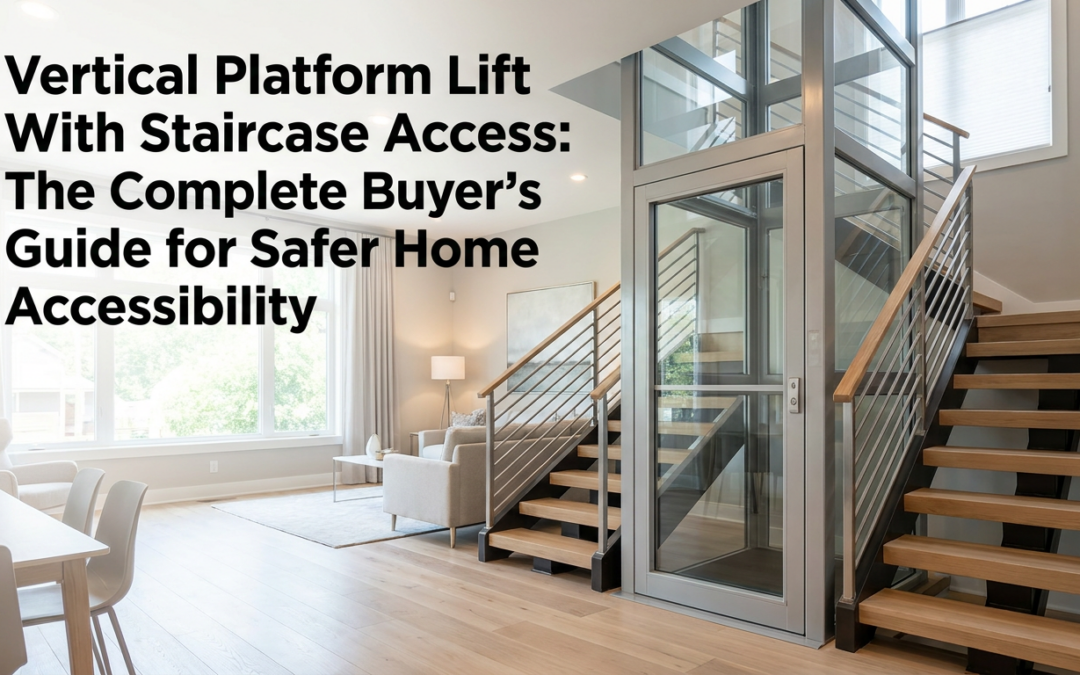
Picture a front porch with four steps between the door and the driveway. A wheelchair user can’t get up them safely. A ramp would need to extend more than thirty feet to hit the right angle, and there isn’t thirty feet of space. A stair lift won’t work because the user can’t transfer to a seat. This is exactly the situation a vertical platform lift with staircase access is designed to solve, and it’s one we see regularly across Denver and the surrounding Front Range communities.
This guide explains how platform lifts work, how they compare to stair lifts, where they make sense, and what Colorado homeowners need to know before selecting one.
What a Vertical Platform Lift Actually Does
The Mechanics Without the Jargon
A vertical platform lift moves a flat platform straight up and down between two fixed levels. The user, along with any mobility device they’re using, stays on the platform for the entire movement. There’s no staircase rail, no seated chair, no transfer required. The platform rises, reaches the upper level, and the user rolls or steps off.
The distance of travel varies by model and application. Residential units typically handle vertical rises from a few inches up to several feet, which covers the majority of porch step configurations and interior level changes we encounter in Colorado homes.
Where Platform Lifts Are Used in Residential Settings
- Exterior porch access. This is the most common residential application. Entry steps that are too steep or too numerous for a ramp become manageable with a compact platform lift.
- Garage-to-home transitions. Many Colorado homes have a raised interior floor relative to the attached garage. A small platform lift handles this transition cleanly.
- Interior half-level changes. Split-level homes often have a short flight of stairs between main living areas. A platform lift in this location restores access without the cost of a full-floor addition.
- Deck access. Elevated decks that were previously inaccessible become reachable without ramp construction.
Vertical Platform Lift vs. Stair Lift: Choosing the Right Solution
Why This Choice Matters
Selecting the wrong product isn’t just a financial mistake. It’s a safety issue. A stair lift installed for someone who can’t safely transfer to a seat creates a fall risk at the transfer point. A platform lift installed where a stair lift would have worked costs significantly more and occupies more space. Getting this right starts with an honest assessment of the individual’s actual mobility.
A Direct Comparison
| Feature | Stair Lift | Vertical Platform Lift |
| Travel path | Along the staircase rail | Straight vertical |
| Transfer required | Yes, to the seated position | No |
| Best for | Users who can sit and transfer | Wheelchair users, non-transferable users |
| Staircase required | Yes | No |
| Weight capacity | Up to 440 lbs | Varies by model |
| Outdoor-rated models | Available | Available |
| Typical indoor install time | 2 to 4 hours (straight) | Varies by configuration |
What Most Buyers Get Wrong
Here’s the comparison mistake we see most often: families assume a stair lift is always the more affordable solution, so they default to it without confirming the user can safely transfer. The transfer to a stair lift seat involves standing briefly, pivoting, and sitting, which requires a level of balance and leg strength not everyone has. If that transfer isn’t safe, the stair lift creates a new hazard on each trip.
The better question isn’t “which costs less.” It’s “which one the person can actually use without risk.” A free in-home assessment from our team includes watching how the person currently navigates the space, which tells us more than any checklist.
Outdoor Platform Lifts in Colorado: What the Climate Demands
Why Colorado Is Different From the Manufacturer’s Brochure
Colorado’s climate makes outdoor lift selection more specific than it might be in other states. UV intensity at altitude, freeze-thaw cycles through the Front Range winter, and temperature swings that can move thirty degrees in a single day all affect how outdoor equipment holds up over time.
Battery Operated Systems and Power Outages
All models we carry are battery-operated systems, meaning they continue to function when the home loses power. In mountain communities, especially, where winter storms can interrupt electricity for hours or days, this isn’t a minor detail. It’s the difference between someone being stranded on one level and/or being able to move through their home normally.
Maintenance for Outdoor Units
Colorado’s outdoor lifts need more attention than indoor units. We recommend annual service for any exterior installation, with inspection of the track system, drive components, and battery condition before winter. Our service plans cover this kind of scheduled maintenance, so it doesn’t get overlooked.
Weight Capacity: The Specification Families Often Overlook
Standard vertical platform lift models carry weight capacities that vary by manufacturer and model configuration. The specification matters more than most families realize during the buying process, and it’s easier to address it upfront than to discover a mismatch after installation.
For stair lift buyers, Savaria units in our inventory reach 400 lbs capacity, which covers a significant portion of customers who would otherwise find their options limited. Platform lift capacity should be confirmed with the same specificity. Our assessment process includes confirming weight capacity requirements before any equipment is ordered.
Home Accessibility Solutions That Go Beyond a Single Product
Thinking About the Full Path of Travel
One thing that separates a thoughtful home accessibility solution from a single-product installation is considering the full path a person travels through their home. A platform lift at the front porch solves exterior access. It doesn’t help with the interior staircase to the bedroom. A stair lift on the interior staircase doesn’t address the porch.
We’ve worked with families across Colorado who discovered mid-project that they needed two types of equipment because nobody had walked their full route with them. Our free in-home assessments start by tracing the person’s actual daily movement through the home. That prevents the “we fixed the stairs but didn’t think about the porch” situation.
Products We Pair With Platform Lifts
- Modular ramp systems for secondary entry points
- Straight or curved stair lifts for interior staircases
- Grab bar installations at lift landings
- Threshold ramps for doorway transitions
Independent Living Solutions handles all of these as a full-service residential dealer. Families who want a single point of contact for multiple access challenges don’t have to coordinate between multiple contractors.
What the Process Looks Like From Assessment to Installation
Our process is the same regardless of product type:
- Free in-home assessment. We come to your home, evaluate the space, and talk through the options.
- Measurement and evaluation. We document dimensions, clearance, electrical proximity, and structural considerations.
- Transparent quote. You receive pricing with no hidden fees before any commitment.
- Order and lead time. We communicate the timeline honestly, including any fabrication or shipping lead time.
- Installation. A technician will complete the installation and test the system fully.
- Training. We walk you and any involved family members through the operation before we leave.
There are no surprises in that process because there’s nothing to hide.
Choosing between a stair lift and a platform lift is a decision that deserves a real conversation about your home and your situation. Explore our vertical platform lifts and wheelchair lift options or call us at (303) 463-8200 to schedule a free in-home assessment anywhere in the Denver metro or across Colorado.
Frequently Asked Questions
What is the difference between a vertical platform lift and a stair lift?
A stair lift travels along a rail mounted to the staircase and requires the user to transfer to a seated position. A vertical platform lift moves straight up and down on a fixed platform, accommodating a wheelchair without any transfer. The right choice depends on whether the user can safely sit and transfer or needs to remain in their mobility device throughout.
Can a vertical platform lift be installed outdoors in Colorado?
Yes, with the right equipment. Outdoor installations require weatherized track systems and components rated for UV exposure and cold-weather operation. Colorado’s altitude and temperature swings make these specifications more important than in milder climates. All models we install for exterior use are outdoor-rated, and battery-operated systems ensure continued function during power outages.
How much space does a platform lift need?
Platform lift footprints vary by model, but most residential units are compact enough for standard porch configurations. Clearance at the upper and lower levels is the critical measurement. We confirm spatial requirements during the in-home assessment before any equipment is selected or ordered.