
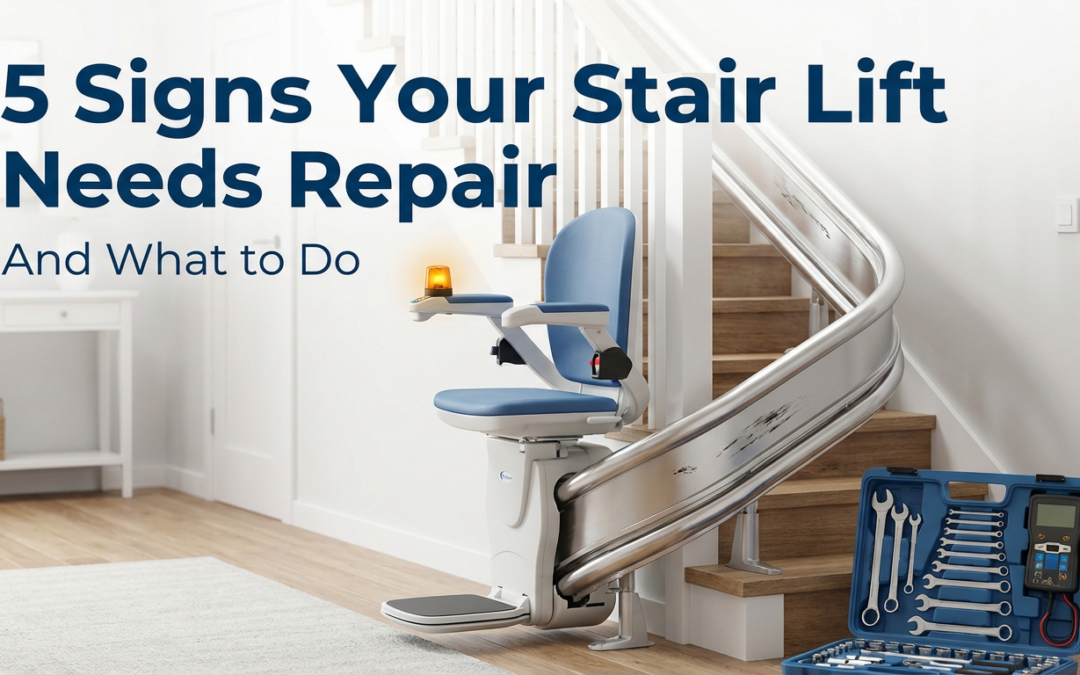
Your stair lift gets used every day. Maybe five times a day. Maybe fifteen. And like any piece of equipment that works that hard, it eventually needs attention. The question isn’t whether it’ll need service; it’s whether you’ll catch the warning signs before it stops working entirely.
I’ve been doing stair lift repair in Colorado for over two decades. I’ve seen lifts that hummed along for years with basic maintenance, and I’ve seen lifts that failed catastrophically because someone ignored the early signals. The difference is usually a few hundred dollars in preventative work versus thousands in replacement, or worse, a stranded family member on the wrong floor.
This guide walks you through the five signs your stair lift needs repair, what each symptom means, and exactly what to do when you spot them. If you’re searching for stair lift repair near me, start here before you call.
Sign 1: Unusual Noises During Operation
A healthy stair lift runs quietly. You should hear a smooth, low hum from the motor and the gentle click of the seat locking into position. When that changes, pay attention.
What to listen for:
- Grinding or scraping sounds from the motor housing
- Squealing from the track during ascent or descent
- Clicking, popping, or rattling that wasn’t there before
- Sudden loud noises when starting or stopping
What it usually means:
Most noise issues trace back to three causes: worn gears in the motor, debris or damage on the track, or failing bearings in the carriage. Colorado’s dry climate and dust can accelerate wear on moving parts. I’ve found everything from accumulated pet hair to cracked track sections causing these sounds.
What to do:
Don’t wait. Unusual noises rarely resolve themselves. Call for stair lift repair in Colorado as soon as you notice the change. Continuing to use a noisy lift can turn a $200 gear adjustment into a $2,000 motor replacement. At Independent Living Solutions, Chase can typically diagnose noise issues within minutes of arrival.
Sign 2: Jerky Movement, Hesitation, or Speed Changes
Your stair lift should move at a consistent, steady pace. If it’s speeding up, slowing down, or stopping mid-ride, something is wrong.
What to watch for:
- The lift pauses briefly during travel, then resumes
- Noticeable speed variation between floors
- Sudden stops that require resetting
- Rough or vibrating movement that wasn’t present before
What it usually means:
Jerky operation usually indicates electrical issues – failing batteries, loose wiring connections, or a dying circuit board. In Colorado, power fluctuations from winter storms can stress electrical components. Battery-powered lifts, such as the Savaria models we install, are designed for outage protection, but batteries degrade over time.
What to do:
Document when the hesitation happens. Is it at a specific point on the track? After the lift has been idle? During cold weather? This information helps Chase diagnose faster. Most electrical repairs are straightforward: battery replacement, connection tightening, or circuit board swap, but they require a technician. Don’t attempt electrical work yourself.
Sign #3: The Lift Won’t Start or Respond to Controls
You press the button. Nothing happens. Or the lift starts, then stops immediately. This is the failure mode everyone fears, and it’s more common than it should be.
What to check first:
- Is the lift plugged in? (Surprisingly often, the answer is no — vacuuming, cleaning, or pets can dislodge cords)
- Is the key switch in the “on” position? (Many lifts have a key lock for safety)
- Are the armrests fully lowered? (Lifts won’t operate unless seated properly)
- Is the battery indicator showing a charge?
What it usually means:
If basic checks don’t solve it, you’re likely looking at: dead batteries, a failed charger, a broken safety switch, or a seized motor. Sometimes it’s a simple fix—I’ve restored service by reconnecting a single wire. Other times, components have reached end-of-life and need replacement.
What to do:
Run through the checklist above. If the lift still won’t respond, call for stair lift repair near me immediately. A non-functioning lift isn’t just inconvenient; it can trap someone upstairs or downstairs. We prioritize these calls and often provide same-day service for complete failures.
Sign 4: The Track Feels Loose or the Seat Wobbles
Physical instability is never normal. Your stair lift should feel solid, secure, and predictable every time you sit down.
What to check:
- Does the seat shift or rock when you sit?
- Can you move the track by hand? (You shouldn’t be able to)
- Are there visible gaps between the rail and the stairs?
- Does the footrest droop or fail to stay in position?
What it usually means:
Loose components indicate installation issues, worn brackets, or structural problems. Sometimes the original installer didn’t anchor properly to the stair treads. Sometimes, years of vibration have loosened hardware. Occasionally, the stairs themselves have shifted—common in Colorado’s expansive clay soils.
What to do:
Stop using the lift immediately. Instability is a safety hazard. A wobbling seat can lead to falls; a loose track can derail the carriage. This isn’t a DIY fix. Improper tightening can strip threads or crack components. Call for professional stair lift repair in Colorado. Chase will inspect every anchor point, torque specifications, and structural integrity before clearing the lift for use.
Sign 5: Error Codes, Beeping, or Warning Lights
Modern stair lifts communicate when something’s wrong. Don’t ignore them.
What to watch for:
- Flashing LED lights on the control panel
- Audible beeping patterns (often repeating sequences)
- Displayed error codes (numbers or letters)
- Constant beeping when the lift is parked
What it usually means:
Error codes are diagnostic tools. Common triggers include: obstruction sensors activated, battery charging failures, overload conditions, or internal safety system faults. That constant beeping you hear? It’s usually the lift telling you it can’t charge properly, often because the park position isn’t aligned with the charging strip.
What to do:
Check your user manual for error code meanings. If you don’t have it, most manufacturers publish them online. Note the exact pattern: flashing red twice, then solid green, for example. This information gets Chase to the right fix faster. For stair lift repair cost efficiency, accurate diagnosis matters.
What Stair Lift Repair Cost Actually Looks Like
I believe in transparent pricing. Here’s what stair lift repair costs typically range for Colorado homeowners:
| Repair Type | Common Causes | Estimate Range | Timeline |
| Battery replacement | Worn batteries, charging issues | Lower Range | Same day |
| Track cleaning/adjustment | Debris buildup, minor misalignment | Lower Range | 1-2 hours |
| Electrical repair | Wiring, switches, circuit boards | Mid Range | 2-4 hours |
| Motor or gearbox work | Worn gears, bearing failure | Higher Range | May require parts order |
| Complete component replacement | End-of-life major parts | Higher Range | 1-2 days, if parts are in stock |
The only way to know your specific stair lift repair cost is with an in-home evaluation. I don’t guess over the phone. Chase diagnoses the actual problem, quotes the exact fix, and completes most repairs in a single visit. Our local warehouse stocks common parts for the brands we service, such as Handicare, Harmar, Savaria, and others.
We also service lifts we didn’t install. About half of our repair calls are for equipment installed by other companies or purchased online. We’ll fix what we can, and if we can’t (if parts are obsolete or the lift is unsafe), we’ll tell you honestly and discuss replacement options.
The Preventive Maintenance: The Repair You Avoid
Most expensive repairs are preventable. That’s why we offer Preventive Maintenance and Service Plans for Colorado homeowners.
What maintenance includes:
- Annual inspection of all mechanical and electrical components
- Track cleaning and lubrication
- Battery testing and replacement before failure
- Safety sensor calibration
- Hardware torque checks
- Control function testing
What it costs:
Less than one emergency repair call per year. For customers with limited mobility who depend on their lift daily, this is inexpensive insurance against being stranded.
During maintenance visits, Chase often spots wear before it causes failure. A gear showing early wear. A battery holding less charge. A track section is starting to separate. Fixing these early keeps your lift running and keeps stair lift repair costs manageable.
Why Local Service Matters for Stair Lift Repair Near You
When your lift stops working, you need help today—not next week. That’s why searching for “stair lift repair near me” matters.
National retailers and online sellers don’t have Chase. They don’t have a Wheat Ridge warehouse stocked with parts. They don’t have 20 years of Colorado-specific experience with the issues our climate and power grid create.
At Independent Living Solutions, we’re local. Same-day service calls happen because we’re actually here, not routing you to a contractor network. We know Denver homes, Colorado Springs layouts, Evergreen’s steep staircases, and the specific challenges of Front Range mobility equipment.
Our repairs are backed by our 1-year labor warranty. If we fix it and the same issue returns, we make it right.
When Repair Isn’t The Right Choice
Sometimes I tell customers not to repair. It sounds bad for business, but it’s essential for trust.
Consider replacement instead when:
- The lift is over 15 years old, and major components are failing
- Parts are obsolete and unavailable
- Multiple systems are failing simultaneously
- The original installation was substandard and unsafe
- Repair costs exceed 50% of replacement value
In these cases, we discuss options: new straight stair lifts ($4,100–$4,900 installed), recycled units ($2,900–$3,700), or whether a different solution, like a vertical lift, makes more sense. Our buy-back program applies if you have equipment to trade in.
If your lift is showing any of the five signs above, or if something just feels off, don’t wait for complete failure. A quick call can prevent a crisis.
Call (303) 463-8200 for “stair lift repair near me” in Denver, Colorado Springs, Evergreen, Wheat Ridge, and surrounding Front Range communities. Chase and I typically schedule within a few days for non-urgent issues and prioritize complete failures same-day when possible. We’ll diagnose, quote, and repair— honestly and efficiently.
Learn more about our stair lift services.
FAQs
Q: How much does stair lift repair cost in Colorado?
It depends on the specific issue. Simple repairs, such as battery replacement or track adjustment, are at the lower end. Motor or gearbox work costs more. The only accurate stair lift repair cost comes from an in-home diagnosis. I don’t guess over the phone. Chase and I evaluate the actual problem and give you exact pricing before any work begins.
Q: Do you repair stair lifts from other companies?
Yes. About half of our repair calls are for lifts we didn’t install. We service Handicare, Harmar, Savaria, and most other major brands. If we can fix it safely and economically, we will. If parts are obsolete or the lift is beyond repair, we’ll tell you honestly and discuss replacement options.
Q: How quickly can you respond to a repair call?
For complete failures where someone is stranded, we prioritize same-day service when possible. For non-urgent issues like unusual noises or minor hesitation, we typically schedule within a few days. Being local to Wheat Ridge with a stocked warehouse lets us respond faster than national companies.
Q: Is it worth repairing an old stair lift, or should I replace it?
Depends on age, condition, and repair scope. If the lift is under 10 years old and needs minor work, repair usually makes sense. If it’s over 15 years old with major component failure, replacement is often more economical long-term. I’ll give you an honest assessment and I’d rather earn your trust with the right recommendation than charge for a repair that won’t last.