by Chase | Jul 23, 2026 | Stair Lift
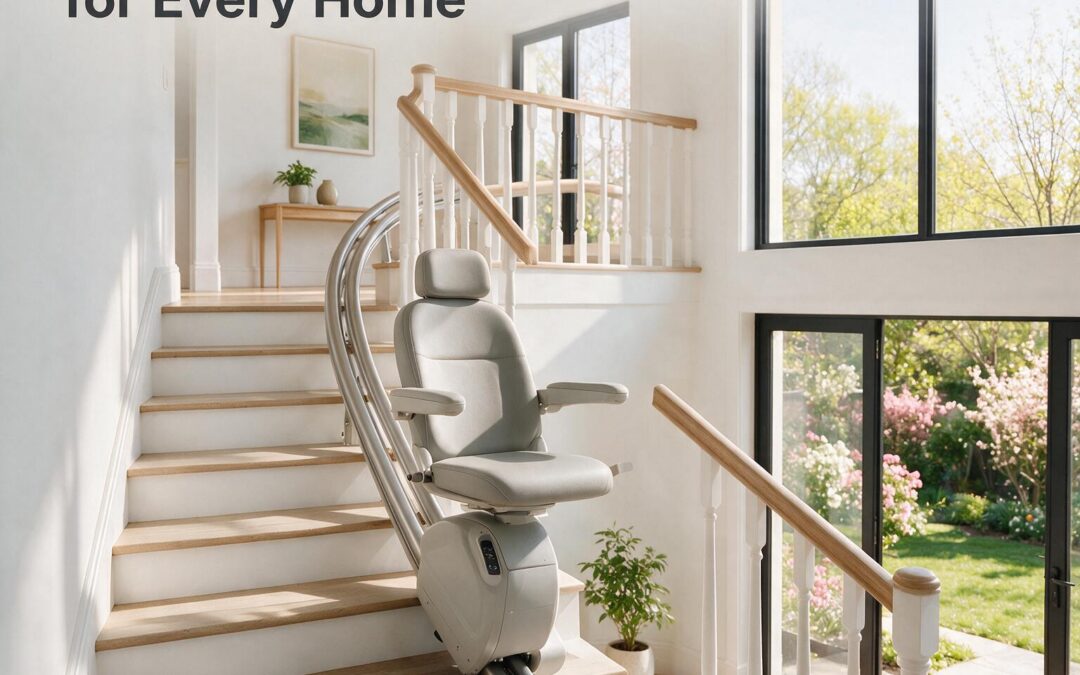
The first thing I do when I walk into a home with a curved staircase is look at it carefully before I say anything. Some of these staircases were built a hundred years ago by craftsmen who took real pride in the geometry. A graceful sweep up to the second floor, a tight spiral in a Capitol Hill Victorian, a switchback with a carved newel post that the homeowner’s grandmother picked out in 1952. These aren’t just functional structures. They’re part of the home.
I say this because the families who call us about curved residential chair lifts are sometimes braced for bad news. They’ve been told their staircase is too complicated, or the cost is too high, or it can’t be done without damaging the character of the stairs. Most of the time, that’s not true. Custom stair lifts for curved staircases in Colorado have been our specialty since we opened in 2008, and what we’ve learned is that the staircase almost always has a solution. It just takes the right process to find it.
How Curved Residential Chair Lifts Actually Work
Not a Bent Version of a Straight Rail
This is the first thing worth understanding: a curved residential chair lift is not a straight lift with a bend added. It’s a different product category with a fundamentally different manufacturing process.
A straight lift uses a standard rail cut to length and adjusted for the staircase angle. The rail comes from a warehouse. A curved lift uses a rail that is custom-bent, welded, and formed to follow the precise geometry of a specific staircase. That rail is fabricated specifically for your home and won’t fit any other staircase in the world. The chair on a curved system also rotates at turns to keep the user properly oriented throughout travel, which adds mechanical complexity that straight-rail systems don’t require.
What the Chair Itself Handles
The seat swivels at the top of the staircase to allow safe dismount. Footrests and armrests fold to keep the staircase usable by other household members when the lift is parked. Controls are typically joystick-operated at the chair and also include remote call and send functions so the lift can be summoned from either level.
Weight capacity on standard curved units is 300 lbs. There is an option for a 350-lb weight capacity.
Staircase Types We Build Custom Rails For
The Range Is Wider Than Most Families Expect
When people hear “curved stair lift,” they often picture a single type of staircase. The reality is that custom stair lifts for curved staircases in Colorado cover a wide range of configurations, including some that feel genuinely complex until you’ve done a few of them.
- 90-degree turns. One of the most common configurations in Denver-area homes, especially post-war construction where the staircase changes direction at an intermediate point.
- 180-degree switchbacks. The second flight runs parallel to the first in the opposite direction. The rail completes a full U-turn between flights.
- Spiral staircases. Continuous curves from bottom to top. These require the most precise fabrication and the most careful installation, but they’re achievable.
- Multiple landings. Staircases that include flat transition areas between flights require a rail that follows the stairs, traverses the landing, and transitions smoothly into the next flight.
- Steep or narrow curves. Some older Colorado homes have staircases that are both curved and tight. We measure for clearance during the assessment to confirm the chair can travel without obstruction before anything is ordered.
When Straight Stair Lifts for Sale Solve Part of the Problem
There are configurations where two straight stair lifts for sale, one on each flight, with a short transfer across a landing between them, cost significantly less than a single curved system. This isn’t always practical, and it requires the user to be able to stand briefly for the transfer, but it’s worth discussing honestly during the assessment. We carry straight stair lifts for sale in stock and can often install them the same week, which matters when timing is urgent.
The Custom Planning Process: Photography, Measurement, and CAD
Why This Takes More Time Than a Straight Installation
Straight stair lift installations often happen within the same week as the assessment because we stock those units in our local warehouse. Curved lifts require a different timeline, and understanding why helps families plan without frustration.
The process for a curved installation looks like this:
- Free in-home assessment. We visit the home, walk up the staircase, and discuss what the person needs. No commitment required.
- Photography and detailed measurement. We document every dimension: tread depth, riser height, angles at each turn, landing widths in configurations with multiple landings, ceiling clearance, and distance to power sources.
- CAD rail design. The measurements go to the manufacturer, who produces a CAD drawing of the proposed rail geometry.
- Homeowner approval. We share the drawing with the homeowner for review before fabrication begins. This step prevents surprises at installation.
- Custom fabrication. The rail is bent and welded to the approved specifications. This is where the lead time comes from. Precision fabrication takes time.
- Installation. A technician mounts the rail to the stair treads, not the walls, fits the chair system, and runs the full travel path to check alignment.
- Testing and training. Every installation is tested under load and every user is trained on operation, parking positions, and safety features before we leave.
The one-year labor warranty on new installations covers this full process. Manufacturer warranties extend coverage for equipment issues beyond that period. Service plans are available for families who want scheduled annual maintenance going forward.
Installation Best Practices: Protecting the Staircase
The Rail Mounts to the Treads, Not the Walls
The most common concern we hear from families with architecturally significant staircases is damage. They don’t want brackets in the plaster, holes in the wainscoting, or anything that compromises the staircase they’ve lived with for decades.
The rail system mounts to the stair treads. That’s the correct installation method regardless of staircase style, and it means the walls are untouched. The tread fasteners are appropriate for the tread material, whether that’s hardwood, carpet over wood, or another surface. If the lift is ever removed, the tread fasteners come out, and the staircase is structurally unchanged.
Curved installations take six to ten hours on installation day. The house stays functional throughout. We don’t need to close off rooms or move furniture on other floors.
Curved Stair Lift Repair in Colorado: What Happens After Installation
Why Local Service Matters More for Curved Systems
Curved stair lift repair in Colorado is not the same as repairing a straight unit. The rail is unique to the staircase. A technician who hasn’t seen the system before needs to understand the specific geometry before diagnosing any issue. Remote troubleshooting from a national call center has real limitations here.
We provide local service across the Front Range and surrounding communities, which means the technician who comes for a repair call is familiar with the brands we install and can work from the installation documentation we keep on file.
Common Issues That Come Up Over Time
- Rail alignment. Homes settle. Temperature cycles through Colorado winters can cause minor shifts. Annual service catches alignment issues before they become operational problems.
- Battery condition. Curved lifts operate as battery-operated systems, which means they run independently of wall power. Batteries have a service life and should be checked and replaced on a schedule.
- Motor and drive mechanism wear. Normal use over years produces gradual wear in drive components. Scheduled maintenance identifies this before it causes a failure.
- Call station and remote function. These are the first components to show wear in high-use systems and are straightforward to service when caught early.
Cost and Value: What Curved Stair Lifts Actually Cost in Colorado
Honest Numbers
Curved stair lift installations start around $14,000 installed. Price increases from there based on staircase complexity, rail length, number of turns, and any specialized configuration requirements. These are installed prices, meaning measurement, fabrication, delivery, installation, testing, and training are all included.
That number lands differently depending on the alternative. Assisted living in Colorado costs tens of thousands of dollars per year at most facilities. Moving to a single-level home in Denver’s current market involves real estate costs, moving expenses, and the disruption of leaving a home someone has lived in for decades. For most families, the math is not close.
Your staircase shouldn’t be the reason you leave a home you love. Our team has been building and installing curved stair lift systems for Colorado homes since 2008, and we’d like to walk your staircase with you. Schedule a free in-home assessment by calling (303) 463-8200 or emailing info@independentlivingsolutionsinc.com. We serve the Front Range and surrounding Colorado communities, and the assessment costs you nothing.
Frequently Asked Questions
Can a curved stair lift be installed on a spiral staircase?
Yes. Spiral staircases are among the more complex configurations we handle, but the custom fabrication process allows the rail to follow a continuous spiral from bottom to top. The precision required is high, which is why the measurement and CAD design steps matter so much. We confirm fit before fabrication begins, so there are no surprises on installation day.
How long does a curved stair lift installation take?
Installation day typically runs six to ten hours for a curved system. That’s the time from our technician arriving to the lift being tested and the homeowner being trained on operation. The longer part of the total timeline is custom fabrication, which happens before installation day. We give families a realistic lead time at the assessment stage so they can plan appropriately.
Is it worth repairing a curved stair lift, or should I replace it?
It depends on the age of the unit, the nature of the problem, and the cost of the repair relative to replacement. Most mechanical issues, including motor wear, battery replacement, and rail alignment, are worth repairing because the custom rail itself is still sound and a replacement would require new fabrication at full cost. We assess each situation individually and give you an honest recommendation rather than defaulting to replacement.
What is the difference between a curved and a straight stair lift for Colorado homes?
A straight stair lift uses a standard rail on a single uninterrupted flight of stairs. A curved lift uses a custom-fabricated rail built for a specific staircase with turns, multiple landings, or spiral sections. Straight lifts are faster to install and lower in cost. Curved lifts require a longer lead time and a more detailed planning process, but they’re the only solution for staircases that aren’t straight. We stock straight stair lifts for sale for same-week installation in many cases, while curved systems require scheduling around the fabrication timeline.
by Chase | Jul 17, 2026 | Stair Lift
A woman in Lakewood called us last year. She’d already paid a national retailer to ship a stair lift to her home. The box sat in her garage for three weeks before she figured out no local technician would touch it for liability reasons. The unit sat there while her mother slept downstairs because the upstairs bedroom was no longer accessible. That situation shouldn’t happen to anyone.
Choosing a stair lift dealer near you isn’t just about price. It’s about whether someone actually shows up, measures your specific staircase, installs the right equipment, and comes back when something needs attention. This guide walks through exactly what to look for and what to avoid.
Why Local Stair Lift Dealers Outperform National Retailers
The Service Gap Nobody Talks About
National retailers can ship equipment quickly. What they can’t do is send someone to your home in Evergreen when the lift stops working on a February evening. That gap between purchase and service is where a lot of families find themselves stuck.
A local stair lift dealer maintains relationships with customers after the sale. At Independent Living Solutions, we’ve been operating out of Wheat Ridge since 2008, and our service area covers the Front Range and surrounding Colorado communities. When a service call comes in, we respond locally. That’s not a marketing claim. It’s just how a small business has to operate to stay in business.
What Local Dealers Actually Provide That National Chains Don’t
- A free in-home assessment before any equipment is ordered
- A technician who physically measures your staircase rather than guessing from photos
- A showroom where you can sit in the equipment before committing
- Direct accountability when something goes wrong
The free in-home assessment matters more than most families realize. Staircase dimensions, ceiling clearance, tread depth, and the distance to the nearest outlet all affect which product fits and how it’s installed. A dealer who quotes you over the phone without seeing the space is guessing.
What to Look For When Evaluating a Stair Lift Dealer
Accreditation and Track Record
BBB A+ accreditation isn’t the only marker of a reputable dealer, but it’s a baseline. Independent Living Solutions has held BBB A+ accreditation since January 2009. That kind of standing takes consistent customer service over years, not just a good week.
Ask how long the company has been operating. Ask whether they handle their own installations or subcontract to third parties. Ask whether the technician who installs your lift is the same person who will service it.
Inventory Depth and Brand Range
A dealer who carries only one brand has a commercial reason to sell you that brand regardless of whether it fits your situation. We carry Handicare, Harmar, Savaria, and Bruno units because different bodies, different staircases, and different budgets need different solutions.
This matters especially when you’re looking at handicap lifts for sale across multiple categories. A straight stair lift, a curved residential chair lift, and a residential vertical platform lift are genuinely different products designed for different situations. A dealer who treats them as interchangeable probably doesn’t know them well enough to help you choose correctly.
Honest Pricing Without Hidden Fees
Here’s what pricing from a straightforward dealer looks like:
| Equipment Type |
Condition |
Installed Price Range |
| Straight stair lift |
New |
$4,100 to $4,900 |
| Straight stair lift |
Certified pre-owned |
$2,900 to $3,700 |
| Curved stair lift |
New (custom) |
Starting around $14,000 |
These are our actual installed prices. “Installed” means the technician comes to your home, mounts the rail to the stair treads (not the walls), tests the system under load, and trains you on operation before leaving. There are no separate delivery fees, no labor add-ons.
New vs. Certified Pre-Owned Stair Lifts: What Most Dealers Won’t Tell You
The Honest Comparison
What most dealers won’t tell you is that certified pre-owned straight stair lifts go through the same professional inspection and installation process as new units. The difference is the price, the manufacturing date, and the warranty terms.
New straight stair lifts carry a one-year labor warranty on installation and full manufacturer warranty coverage. Pre-owned units cost up to $1,200 less but have more limited warranty terms. For a family on a fixed income who needs a solution on a standard straight staircase, a certified pre-owned unit installed by our team is often exactly the right choice.
Where pre-owned doesn’t make sense: curved residential chair lifts. Because each curved rail is custom-fabricated for a specific staircase, a used curved rail almost never transfers to a different home. If you need a curved lift, you’re looking at a new custom installation.
Rental as a Short-Term Option
Not every mobility need is permanent. Hip replacements, knee surgeries, and injury recoveries often create a temporary stair access problem. Rental options mean you’re not paying for permanent equipment when you need three months of coverage. Ask any dealer you’re evaluating whether they offer rentals. A dealer who only sells won’t mention this.
Understanding the Product Categories: Which One Do You Actually Need?
Stair Lifts vs. Residential Vertical Platform Lifts
These are different products for different needs, and a dealer who sells you the wrong one has done you a disservice.
A stair lift carries a seated user along a rail mounted to the staircase. The user must be able to transfer from a wheelchair or a standing position to the lift seat. Most models carry 300 to 400 lbs, depending on the manufacturer. Units in our inventory reach 400 lbs capacity for customers who would otherwise be excluded by standard weight limits.
A residential vertical platform lift moves a user vertically on a flat platform. The wheelchair stays with the user. No transfer is needed. This product is for exterior porch access where a ramp isn’t practical, or for interior level changes where the person cannot safely transfer to a seat.
Getting this distinction wrong is expensive and disruptive. A good in-home assessment from a knowledgeable dealer identifies which product actually fits before anything is ordered.
Curved vs. Straight: The Shape of the Staircase Determines Everything
If your staircase runs in a single uninterrupted line, you need a straight lift. If it has turns, multiple landings, or curves, you need a curved lift with a custom-fabricated rail. The rail on a curved system is built specifically for your staircase using photography, detailed measurements, and a CAD drawing that you approve before fabrication begins.
Installation timelines differ significantly. Straight lifts often install within the same week because we stock them. Curved lifts require custom fabrication, so the lead time is longer. We communicate that timeline clearly at the assessment stage so families can plan accordingly.
Red Flags to Watch for When Choosing a Dealer
Before you commit to any company, run through this list:
- They quote you without seeing the staircase. No legitimate dealer can give you an accurate price without an accurate measurement.
- They can’t tell you who installs the equipment. Subcontracted installation means no continuity of service.
- They carry only one brand. Single-brand dealers have a conflict of interest in every recommendation they make.
- They don’t mention the rail mounts to the stair treads. Some homeowners worry about wall damage. The rail doesn’t touch the wall. A dealer who doesn’t clarify this doesn’t know their product well.
- There’s no buyback program. When the equipment is no longer needed, you should have an exit option. We buy back qualifying units, so families aren’t left figuring out disposal on their own.
Ready to talk through what your staircase actually needs? Start with our stair lifts available for Colorado homes and schedule a free in-home assessment. Our team visits your home, measures the space, and gives you a transparent quote before you make any decision.
Frequently Asked Questions
How do I know if a stair lift dealer is reputable?
Look for BBB accreditation, years in operation, and whether they carry multiple brands. More importantly, ask whether they conduct free in-home assessments and who performs the installation. Dealers who measure your specific staircase before quoting are operating with more integrity than those who sell remotely.
What is the difference between a stair lift and a vertical platform lift?
A stair lift carries a seated user along a rail on the staircase. A vertical platform lift moves a flat platform straight up and down between two levels. Platform lifts accommodate wheelchairs without requiring a transfer, which makes them the right choice for wheelchair users who can’t safely move to a seated position
Can I buy a used stair lift from a private seller and have it installed?
You can, but most reputable dealers won’t install equipment they haven’t inspected. Private-sale units often lack documentation of service history, and parts compatibility can be a problem. A certified pre-owned unit from a dealer like ours comes with a professional inspection and professional installation.
Are curved residential chair lifts worth the higher cost?
For most families, yes. The cost of a curved stair lift starts around $14,000 installed, which is significantly more than a straight unit, but it’s a fraction of what assisted living or a home move costs over time. Staying in a familiar home, with full access to every level, has both financial and quality-of-life value that most families conclude is worth the investment.
by Gary | Jul 5, 2026 | Stair Lift
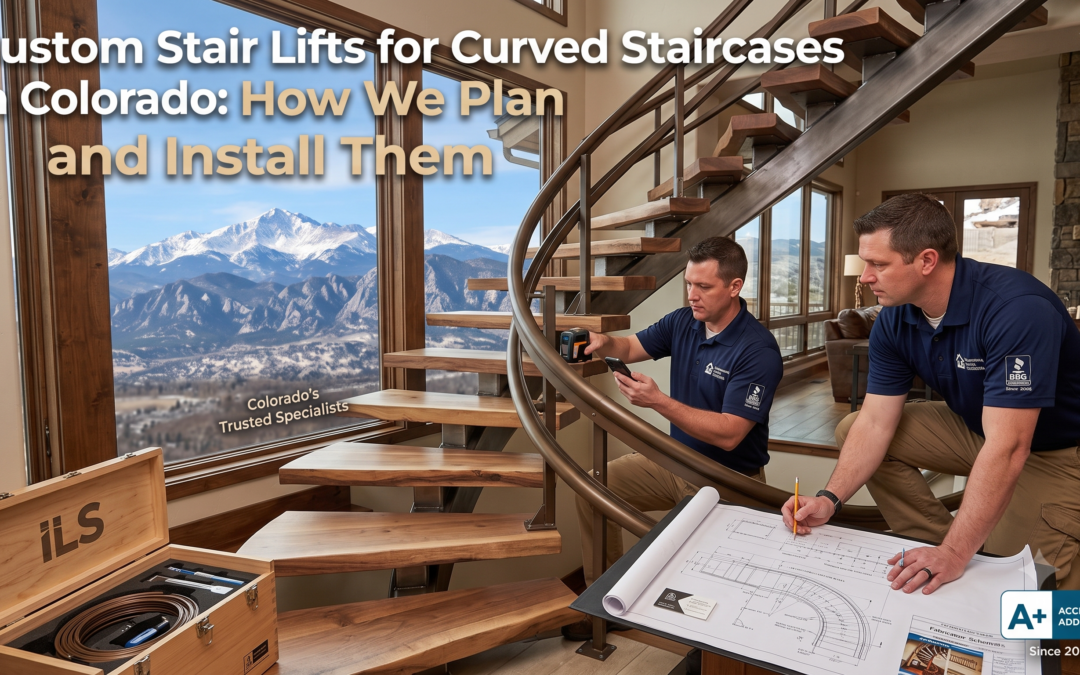
Curved staircases are among the most beautiful architectural features in a home. They are also among the most challenging accessibility problems we encounter. The graceful sweep of a Victorian staircase in Capitol Hill, the tight spiral steps of a mountain-community cabin, the 180-degree turn of a split-level landing in Evergreen, none of these can be served by a standard straight lift rail pulled from a warehouse shelf.
When a homeowner calls us about curved residential chair lifts, the first thing we address is the concern we hear most often: that a custom solution will be prohibitively expensive, invasive, or permanently alter their staircase. In most cases, none of those things are true. Custom does not mean destructive. A curved stair lift rail is fabricated to fit the staircase precisely and mounts to the stair treads, not the walls, leaving the staircase structurally unchanged.
Colorado homes have more curved and complex staircases than many homeowners realize. If you have been told a stair lift will not work in your home, or if you assumed the cost would be too high to consider, this guide walks through exactly what we do, what it costs, and how to get started.
How Curved Residential Chair Lifts Differ From Straight Models
Curved residential chair lifts are not simply bent versions of straight lifts. They are fundamentally different products that require a different manufacturing process, a different assessment approach, and a different installation methodology.
- Custom-bent rail fabrication. A straight lift uses a standard rail cut to the appropriate length, while a curved lift uses a rail that is bent, welded, and shaped by the manufacturer to follow the exact geometry of a specific staircase. No two curved rails are the same.
- Measurement precision. Rail fabrication requires detailed measurements of every angle, turn, tread depth, riser height, and horizontal transition in the staircase. An error of even a few degrees can result in a rail that does not fit correctly. This level of precision is one reason we have maintained our A+ BBB rating since 2009. Details matter, and our measurement process leaves no room for error.
- Chair design and travel path. On a curved lift, the chair must rotate at turns and transitions to keep the user seated safely at all points along the travel path. This adds mechanical complexity that straight-rail systems do not require.
- Weight capacity. Most standard curved residential chair lifts carry 300 lbs. Some models, including Savaria units in our inventory, accommodate up to 400 lbs. This is an important specification to confirm during assessment, as options are more limited in the curved lift category.
- Longer fabrication lead time. Because each curved rail is custom-made, lead time from order to delivery is longer than for straight lifts, which we often carry in stock. We give homeowners a realistic timeline at the start of the process.
Staircase Types We Customize For
We work with a wide range of staircase configurations across Colorado homes. Here are the types we encounter most often.
- Spiral staircases. Tight spiral configurations require precise rail geometry to follow the curve continuously. These are among the most complex curved lift installations, but they are achievable with the right fabrication and installation approach.
- Intermediate landings. Many Colorado homes have staircases with a flat landing partway up, often where the staircase changes direction. The rail must follow the staircase, travel across the landing, and transition into the next flight.
- 90-degree turns. A staircase that turns 90 degrees between flights is one of the most common curved configurations we see. The rail is fabricated to follow the turn smoothly, with the chair rotating at the appropriate point.
- 180-degree turns. Full switchback staircases, where the second flight runs parallel to the first in the opposite direction, require a rail that completes a 180-degree transition. These are more complex to fabricate and install, but are well within the range of what curved residential chair lifts can handle.
- Narrow or steep curves. Some staircases combine a tight curve with a steep angle or narrow width. We measure for clearance during the assessment to confirm that a curved lift will provide adequate room for household members to pass on the staircase.
- When straight stair lifts for sale work with hybrid solutions. In some cases, a staircase with a short intermediate landing can be served by a pair of straight stair lifts for sale, with the user stepping across the landing between the two units. This is a less common approach, but it can significantly reduce costs in the right configuration. We walk through this option when it is a genuine fit.
Our Planning and Assessment Process
The planning process for custom stair lifts for curved staircases in Colorado begins well before any equipment is ordered. Getting it right at this stage is what determines whether the installation goes smoothly.
- Free in-home consultation. A member of our team visits the home with no obligation. We evaluate the staircase, discuss the individual’s mobility needs, and walk through the options before any commitment is made.
- Photography and detailed measurement. We document the staircase with photographs and take comprehensive measurements of every dimension the fabricator will need. This includes tread depth, riser height, angles at every turn, landing dimensions, and clearance from walls and handrails.
- CAD rail design and approval. The measurements are submitted to the manufacturer, who produces a CAD drawing of the proposed rail. In most cases, we share this with the homeowner for review before fabrication begins.
- Approval and fabrication. Once the design is approved, the rail goes into production. Fabrication lead time varies by manufacturer and order volume. We communicate the timeline clearly and follow up with updates.
- Stock straight rails versus custom curved fabrication. Straight stair lifts for sale from our local warehouse are often available for same-week installation. Custom curved rails take longer, and homeowners should plan for this when timing is a factor.
As a BBB A+ accredited provider of custom stair lifts for curved staircases in Colorado, our process is built around precision from the first measurement to the final safety check.
Installation Best Practices We Follow
The installation of a curved stair lift is more involved than a straight installation, and the practices our technicians follow reflect that complexity.
- Minimal wall intrusion. The rail is mounted to the stair treads, not the wall, which preserves the structural and aesthetic integrity of the staircase and means no wall patching is required if the lift is ever removed.
- Preserving staircase integrity. We use appropriate fasteners and mounting hardware for the stair tread material. Hardwood treads, carpeted treads, and tile treads all require different approaches.
- Power supply integration. The lift needs a power source, typically a standard outlet near the top or bottom of the staircase. If one does not exist, we coordinate with an electrician in advance.
- Load testing and emergency function testing. Every installation is tested under load before we leave. Emergency stop functions, obstruction sensors, and call and send remotes are all verified as part of the standard process.
- User training on parking positions and call stations. Curved lifts have specific parking positions at the top and bottom of the staircase where the chair must be parked to keep the staircase clear for other household members. We walk through this and all other operating procedures before the installation is considered complete. We do not consider an installation complete until the homeowner is fully comfortable operating the system. That standard is part of why we have maintained our A+ BBB rating for over 15 years.
Repair and Maintenance for Custom Lifts
Because every curved stair lift rail is unique, maintenance and repair for these systems require familiarity with the specific installation. This is one of the clearest reasons why local service matters for curved lift owners.
- Annual service recommendation. We recommend an annual service visit for all curved stair lifts. A trained technician inspects rail alignment, drive mechanism condition, battery health, and safety sensor function. Catching small issues early prevents larger failures.
- Common issues over time. Rail alignment can shift slightly as a home settles or as temperature changes affect the staircase structure. Motor wear, battery degradation, and occasional sensor calibration drift are the most common issues we address during service calls.
- Battery replacement. Most stair lift batteries have a service life of several years. We track battery age for our service customers and recommend replacement proactively rather than waiting for a failure.
- Warranty considerations. New curved stair lift installations through our team carry a one-year labor warranty. Manufacturer warranties cover equipment defects beyond that period. We also offer service plans for ongoing scheduled maintenance.
- Why local service matters for custom equipment. A curved rail that was fabricated for a specific staircase in a specific home is not something a remote service center can diagnose over the phone. Curved stair lift repair in Colorado requires a technician who can come to the home, assess the specific installation, and work with equipment they know.
For curved stair lift repair in Colorado, our team serves the Front Range and surrounding communities with local response times.
Cost Guide: Custom vs. Straight Stair Lifts
Understanding cost differences between curved and straight systems helps families plan realistically.
| Stair Lift Type |
Typical Price Range |
Condition |
Notes |
| Curved Stair Lift |
Starting around $14,000 |
New (Custom) |
Price varies with staircase complexity |
| Straight Stair Lift |
$4,100 – $4,900 |
New |
Standard rail, in-stock units available |
| Straight Stair Lift |
$2,900 – $3,700 |
Certified Pre-Owned |
Same installation warranty |
| Hybrid (Two Straight Lifts) |
Varies |
New or Pre-Owned |
For some landing configurations |
- Curved stair lifts start around $14,000 installed, with pricing increasing based on the complexity of the rail geometry, the number of turns, and the length of the staircase. More complex configurations can exceed this starting point.
- Straight stair lifts for sale from our inventory run $4,100 to $4,900 new and $2,900 to $3,700 for certified pre-owned units. These are meaningfully more affordable, which is why confirming the staircase type during assessment is the first step.
- Reconditioned options are limited for curved lifts. Because each curved rail is custom-made for a specific staircase, pre-owned curved lift components rarely transfer to a different home. We are transparent about this, so families are not expecting a used curved lift option that does not exist.
- Financing is available. We work with families who need to spread the cost over time. Financing options are discussed during the assessment and applied to the final quote.
Your Curved Staircase Is Not a Barrier
Curved and complex staircases do not have to end the conversation about aging in place. With the right custom stair lifts for curved staircases in Colorado, nearly any staircase configuration can be made fully accessible without altering the home’s structure or appearance.
Our BBB A+ accredited team has completed curved stair lift installations across Colorado, and every one started with a free in-home assessment. If you are ready to find out what is possible in your home, visit our website to learn more about our curved lift options or call us at (303) 463-8200. You can also reach us by email at info@independentlivingsolutionsinc.com or visit our showroom at 6225 W. 48th Ave. #108, Wheat Ridge. There is no obligation, and we will give you an honest answer about what will work for your staircase.
Frequently Asked Questions
Q: Can a curved stair lift be installed on any staircase?
In most cases, yes. The custom fabrication process allows curved residential chair lifts to be built for nearly any staircase geometry, including spirals, 90-degree turns, 180-degree switchbacks, and configurations with intermediate landings. The limiting factors are clearance width, which must be adequate for the chair to travel without obstruction, and the condition of the stair treads, which must be structurally sound to support the rail mounting hardware. We confirm both during the free in-home assessment before any equipment is ordered.
Q: How long does a curved stair lift installation take?
Installation typically takes four to six hours once the custom rail arrives. The rail must be fitted to the staircase, adjusted for precise alignment, and fully tested before the installation is complete. This is longer than a straight lift installation but is completed in a single visit in most cases. Total time from initial assessment to completed installation includes fabrication lead time, which varies by manufacturer.
Q: What should I do if my curved stair lift stops working?
Call us directly at (303) 463-8200. For curved stair lift repair in Colorado, we send a technician to the home to assess the specific installation rather than attempting to diagnose remotely. In the meantime, check whether the lift is showing an error indicator on the control panel and whether the power supply is intact. Do not attempt to manually force the chair along the rail. Our team handles all repairs on equipment we have installed, and manufacturer warranties cover qualifying repair needs on newer units.
Q: Is a curved stair lift worth the higher cost compared to moving?
For most families, yes. The cost of a curved stair lift, while higher than a straight unit, is a fraction of what assisted living or long-term care facilities cost annually in Colorado. Many families we work with have compared the numbers directly. Staying in a familiar home, with full access to every level, also carries quality-of-life value that is difficult to price. If the primary concern is cost, we walk through all available options during the assessment, including financing, to make sure the investment is manageable.
by Gary | Jul 3, 2026 | Stair Lift
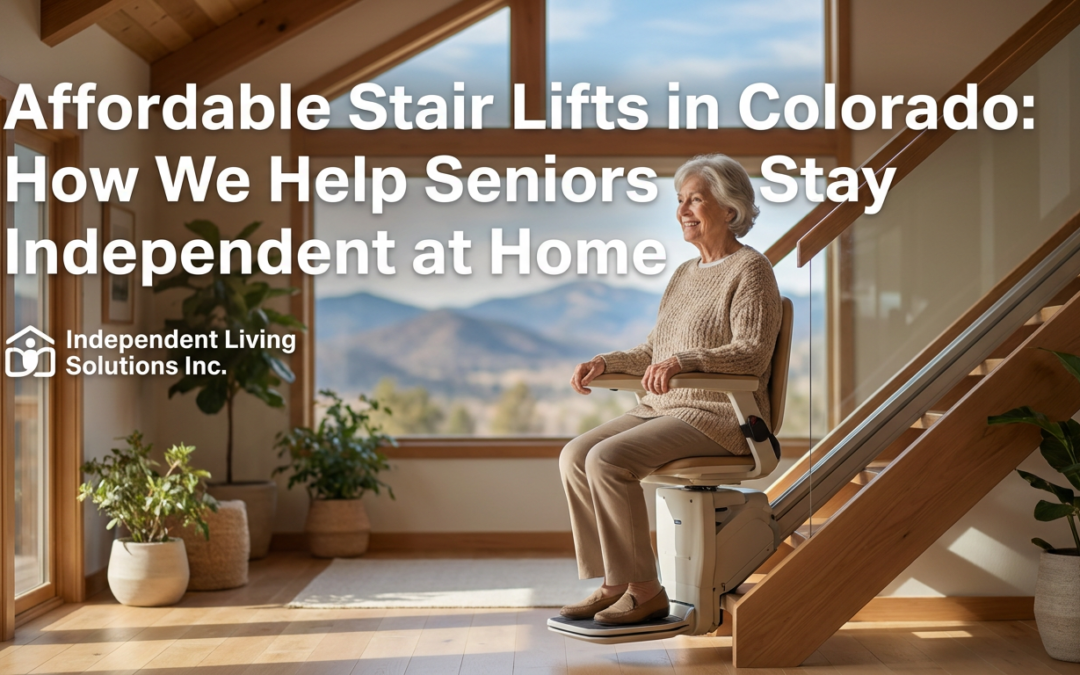
For many Colorado seniors, the staircase that once felt like a minor part of daily life gradually becomes the biggest obstacle to staying home. A knee that has gotten less predictable, a recovery that is taking longer than expected, or a parent who moved in and is no longer steady on their feet. These changes happen slowly, and then all at once.
At Independent Living Solutions, we have helped hundreds of families find stair lifts in Colorado that actually fit their homes, their budgets, and their lives. We are a locally owned mobility equipment dealer based in Wheat Ridge, and we have been doing this work since 2008. We have earned an A+ rating with the Better Business Bureau, and we have maintained that accreditation since January 2009. Our team conducts free in-home assessments across the Front Range and surrounding communities because every staircase is different and every family’s situation is different.
One of the first things families tell us is that they are worried about cost. We hear that concern every week. Our goal is to walk through the options honestly, including both new and certified pre-owned equipment, so families can make a confident decision without financial pressure.
Why Colorado Seniors Choose Stair Lifts Over Moving
Relocating from a family home is rarely just a financial decision. It is an emotional one. When we talk to families about their options, the reasons they want to stay home almost always outweigh the reasons to leave.
- The financial reality of Colorado housing. Moving to an assisted living facility, even a modest one, can cost more than the value of staying put. Installing affordable stair lifts in Colorado is often a fraction of what a single year in a care facility would cost.
- Familiarity and comfort matter to the quality of life. Seniors who age in place tend to maintain stronger social connections and a greater sense of control over their daily routines.
- Multilevel homes are worth keeping. Many Colorado homes have split-level layouts, finished basements, and upper-floor bedrooms that become inaccessible once stairs are a barrier. A stair lift restores access to the whole home, not just the ground floor.
- It avoids the disruption of a move. Selling a home, finding a new one, and adjusting to a new environment carries its own physical and emotional toll, especially during a time when someone is already managing a health challenge.
- Installation is far less disruptive than moving. A standard straight stair lift installation is typically completed in a few hours. There is no weeks-long construction project and no need to alter the home’s structure.
What Affects Stair Lift Pricing in Colorado
Pricing is one of the most common questions we answer during assessments, and it is also one of the most variable. Here is what actually drives the cost.
- Straight vs. curved staircases. A straight staircase uses a standard rail system, which keeps costs lower and installation faster. A curved staircase requires a specifically built custom-fabricated rail for that home’s layout, which significantly increases the price. Our new straight stair lifts are priced from $4,100 to $4,900, installed. Curved lifts start around $14,000, depending on the staircase configuration.
- New vs. certified pre-owned equipment. We stock both. Our certified pre-owned straight stair lifts run $2,900 to $3,700, installed and go through a professional inspection before installation. For families where budget is the primary driver and the staircase is a straightforward straight flight, this is often the right choice.
- Staircase length. Longer staircases require longer rail sections and additional materials, which affect the final price.
- Installation complexity. Tight turns, unusual angles, or narrow stair widths can add time and labor to an installation.
As mobility experts for straight stairlifts in Colorado, our team does not quote from a price list. We measure the actual staircase, evaluate the layout, and give homeowners a transparent quote with no hidden fees before any decision is made.
| Stair Lift Type |
Price Range (Installed) |
Condition |
| Straight Stair Lift |
$4,100 – $4,900 |
New |
| Straight Stair Lift |
$2,900 – $3,700 |
Certified Pre-Owned |
| Curved Stair Lift |
Starting around $14,000 |
New (Custom) |
Indoor vs. Outdoor Stair Lifts and Colorado Weather
Colorado’s climate adds considerations that homeowners in other states may not think about. Between UV exposure at altitude, freeze-thaw cycles, and heavy spring and fall moisture, outdoor stair lifts face real environmental demands.
- Weatherized track systems. Outdoor stair lift rails are designed with sealed components to handle rain, snow, and temperature swings. We always recommend verifying outdoor ratings before any purchase.
- Battery backup is essential in Colorado. All models we carry are battery-powered and continue operating during power outages. In mountain communities especially, this is a baseline feature, not an optional upgrade.
- UV and cold-weather materials. Outdoor lift components should be rated for UV exposure and cold-weather operation. Colorado’s sun at elevation accelerates material wear on equipment not designed for it.
- Covered vs. uncovered installations. A stair lift installed under a covered porch faces different conditions than one fully exposed to weather. We assess each outdoor installation individually.
- When to consider a residential vertical platform lift instead. For porch access or multi-level exterior transitions where a wheelchair user needs to move vertically, a residential vertical platform lift is often a better fit than a stair lift. VPLs provide a flat platform that accommodates wheelchairs and walkers without requiring the user to transfer to a seat. We install both systems and can walk through which makes more sense for a specific home during a free assessment.
Why Work With Local Mobility Experts Like Us
There are national retailers and online options for purchasing stair lifts. What they cannot offer is a technician who knows the Front Range, a showroom where you can sit in the equipment before buying, and a service team that can respond when something needs attention.
- Free in-home assessments with no pressure. We come to your home, measure the staircase, and give you an honest recommendation before you commit to anything.
- Local service response time. Our team is based in Wheat Ridge and serves communities across Colorado. When a service call comes in, we are not routing it through a national dispatch center.
- Warranty and ongoing support. All new installations carry a one-year labor warranty, and manufacturer warranties cover repair needs beyond that. We also offer service plans for scheduled maintenance.
- Buyback program. When equipment is no longer needed, we purchase qualifying units back. Families are not left figuring out what to do with a stair lift after a loved one no longer needs it.
- We carry multiple brands. Our inventory includes Handicare, Harmar, Savaria, and Bruno stairlifts. Carrying multiple manufacturers means we are recommending what fits the home and the person, not just what we have the most of.
- BBB A+ accredited since 2009. Our rating is publicly verifiable, and we have maintained it through consistent customer satisfaction and transparent business practices.
As mobility experts for straight stairlifts in Colorado, our approach has always been to match the right equipment to the right home rather than sell what is easiest to move.
Our Installation Timeline
Families often assume installation will be a major disruption. In practice, it rarely is.
- Free in-home assessment. We schedule a visit, measure the staircase, walk through the options, and provide pricing with no obligation to proceed.
- Equipment ordering. Straight stair lifts are typically in stock in our local warehouse. Curved lifts require custom fabrication, which adds lead time.
- Installation day. Our technician mounts the rail directly to the stair treads, not the wall. Most straight stair lift installations are completed within two to four hours.
- Safety testing and user training. Before we leave, the lift is fully tested, and the homeowner is walked through operation, safety features, remote functions, and parking positions.
- Ongoing service. Manufacturer warranties cover repairs on new equipment. Service plans are available for long-term maintenance scheduling.
Stay in the Home You Love
Stairs should not be the reason someone leaves a home they have lived in for decades. Affordable stair lifts in Colorado are within reach for most families, and the options are broader than many people realize, from certified pre-owned straight lifts to custom curved systems to residential vertical platform lifts for more complex access needs.
Our team is here to help you figure out what fits. Schedule a free in-home assessment or reach us directly at (303) 463-8200. There is no pressure and no commitment, just an honest conversation about what will work in your home.
Frequently Asked Questions
Q: How much does a basic stair lift cost in Colorado?
For a straight staircase, new stair lifts through our team are priced from $4,100 to $4,900 installed. Certified pre-owned straight lifts run $2,900 to $3,700. Curved stair lifts, which require custom-fabricated rails, start around $14,000 depending on the staircase. A free in-home assessment gives you the exact number for your home, with no hidden fees and no obligation to move forward. We also offer financing options for families who need to spread the cost over time.
Q: Can stair lifts be installed on narrow or steep staircases?
Yes. Many Colorado homes, especially older construction in Denver neighborhoods, have staircases that are narrower or steeper than current building standards. Specialized models are designed for these configurations. Our team measures every staircase before recommending or ordering any equipment, so we know in advance whether a standard or specialized model is the right fit. The assessment process eliminates surprises on installation day.
Q: Are outdoor stair lifts safe in Colorado winters?
Yes, provided the right equipment is selected and maintained. Outdoor-rated stair lifts use weatherized track components and sealed mechanisms designed for freeze-thaw cycles and moisture exposure. All models we carry operate on battery backup, which keeps them running through power outages. We recommend an annual service check for outdoor installations to inspect rail condition, lubrication, and battery health before winter.
Q: When is a vertical platform lift better than a stair lift?
A stair lift is designed for a user who can transfer to a seated position and travel along the staircase. A residential vertical platform lift is better suited for wheelchair users or individuals who need to move a mobility device vertically between levels. VPLs are also a practical option for exterior porch access where the step height makes ramp installation impractical. We install both systems and recommend based on the individual’s mobility needs and the specific layout of the home.
by Chase | May 18, 2026 | Stair Lift
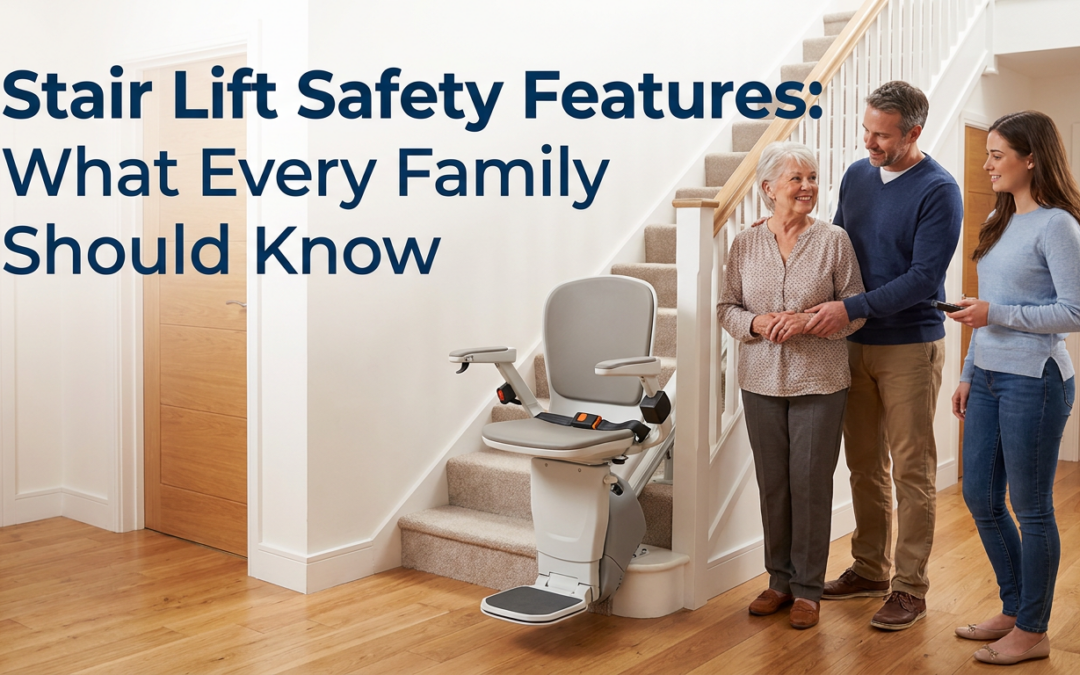
Every family that calls about a stair lift has the same concern beneath the surface: Will Mom or Dad actually be safe on this thing? It’s a fair question. A stair lift is a piece of motorized equipment that carries someone you love up and down a staircase. Safety isn’t a feature – it’s the foundation.
At Independent Living Solutions, we have installed stair lifts in hundreds of Colorado homes, from narrow Victorian staircases in Denver to split-level ranches in Colorado Springs. We’ve seen what works, what families worry about, and which stair lift safety features matter most in real daily use.
This guide covers the essential stair lift safety features every family should understand before choosing equipment. No technical jargon. Just practical information from a team that’s trained Colorado homeowners on hundreds of installations.
Why Safety Features Matter More Than the Sales Pitch
It’s easy to get distracted by price, brand names, or installation timelines. But when the lift is running at 10 PM, and a parent is riding it alone in a quiet house, only the stair lift safety features matter.
The right safety systems prevent falls. They protect against user error. They keep the lift functioning during power outages, emergencies, and everyday moments of uncertainty. And they give adult children (the ones often researching this purchase) peace of mind that their parent is safe, even when nobody else is home.
I approach every assessment with this priority: the lift must be safe enough that I’d put my own family on it.
Essential Stair Lift Safety Features: What to Look For
Not all stair lifts include the same safety systems. Some manufacturers treat features as upgrades. At Independent Living Solutions, we believe these six stair lift safety features should be standard, not optional.
1. Seat Belt and Secure Positioning
A simple lap belt is the first line of protection. It prevents the rider from sliding or shifting during travel, especially on steep staircases common in Evergreen and mountain communities. The belt should be easy to fasten one-handed but secure enough to hold during stops and starts.
Some models include retractable belts that stay tidy when not in use. Others have center-mount designs for easier reach. During a free in-home assessment, I demonstrate how each belt works so families can choose what feels natural for the rider.
2. Swivel Seat with Locking Mechanism
At the top of the stairs, the biggest fall risk isn’t the ride—it’s the transfer. A swivel seat turns 45 or 90 degrees at the landing, allowing the rider to step off facing away from the staircase. The seat then locks in position, so it can’t accidentally rotate mid-transfer.
This feature is non-negotiable for upper-floor safety. We always demonstrate the swivel function during installation and watch the rider practice it before leaving. If hand strength is limited, powered swivel options are available that rotate automatically at the touch of a button.
3. Obstruction Sensors
Modern stair lifts include sensors on the footrest and carriage that detect objects on the stairs, such as a laundry basket, a pet, or a grandchild’s toy. If the sensor triggers, the lift stops immediately. It won’t resume until the path is clear.
This matters in busy Colorado households where stairs double as storage during Denver winters (boots, coats, gear) or where pets move freely. We test these sensors during every installation to confirm they’re calibrated correctly for the specific staircase width and traffic patterns.
4. Battery Backup and Power Outage Protection
Colorado’s mountain communities and Front Range suburbs see power outages from snowstorms, high winds, and grid stress. A stair lift stranded mid-staircase during an outage isn’t just inconvenient; it’s dangerous.
Battery-powered lifts continue operating during outages, typically completing 8–15 trips on reserve power. The batteries charge automatically when the lift is parked at the top or bottom of the rail. This is one of the stair lift safety features I emphasize for homes in Evergreen, Colorado Springs, and anywhere winter weather is unpredictable.
5. Smooth Start and Stop Technology
Jerky movement startles riders. It causes them to grip the armrests, lean, or lose balance. Quality lifts include soft-start and soft-stop motors that accelerate and decelerate gradually.
This is especially important for riders with balance issues, Parkinson ‘s-related movement disorders, or anxiety about the equipment. We always run the lift through several cycles during installation so the rider feels the smooth motion before using it independently.
6. Folding Components and Clear Passage
When not in use, the seat, footrest, and armrests should fold flat against the wall. This keeps the staircase passable for other family members and reduces tripping hazards.
Folding should be simple – manual for most users, powered for those with limited dexterity or strength. I measure staircase width during assessment to confirm folded dimensions leave adequate walking space. In older Denver homes with narrow staircases, this measurement determines whether a lift is viable at all.
Safety Features for Specific Colorado Home Environments
Colorado homes present unique challenges that affect which stair lift safety features matter most.
| Home Type |
Common Challenge |
Recommended Safety Feature |
| Mountain homes (Evergreen, Conifer) |
Steep stairs, power outages |
Battery backup, higher weight capacity, secure seat belt |
| Historic Denver properties |
Narrow staircases, tight landings |
Slim-fold design, swivel seat with limited clearance, obstruction sensors |
| Post-war ranch split-levels (Wheat Ridge, Lakewood) |
Short half-flights, multiple entries |
Smooth start/stop, easy folding for shared stairs |
| Multi-generational homes |
Children, pets, high traffic |
Obstruction sensors, automatic folding, keyed on/off switch |
| Cold-climate entries |
Icy boots, wet surfaces |
Non-slip footrest texture, stable armrest grip |
Chase and I evaluate these environmental factors during every free in-home assessment. A lift that’s perfect for a Denver bungalow may be wrong for a Colorado Springs two-story. Safety features must match the home, not just the rider.
Our Installation Safety Process:
Safety features on paper mean nothing if installation is rushed or training is skipped. At Independent Living Solutions, our installation process includes specific safety protocols:
Step 1: Structural evaluation
Chase inspects the staircase itself – tread condition, railing stability, and wall integrity. The lift mounts to the stairs, not the wall, but the structure must be sound.
Step 2: Rail alignment and anchoring
Every bracket is torque-checked. The rail is leveled precisely. Even minor misalignment can cause binding, noise, or premature wear that compromises safety.
Step 3: Feature testing
Every sensor, belt, swivel lock, and battery system is tested multiple times under load. We don’t assume factory calibration is correct for your specific staircase.
Step 4: Rider training
The rider practices getting on, operating controls, swiveling at the top, folding the seat, and using the remote. Family members are included so they can assist if needed. Nobody is left alone with new equipment until they’re confident.
Step 5: Documentation
Written operating instructions, emergency procedures, and direct contact information for service. Our 1-year labor warranty covers installation-related issues, and Preventive Maintenance plans are available for ongoing safety checks.
When We Recommend Alternatives
Sometimes during assessment, I identify that a stair lift isn’t the safest solution. Maybe the staircase is too narrow for safe passage when folded. Maybe the rider’s condition is progressing rapidly, and a vertical lift or home elevator is a better long-term investment. Maybe the stairs themselves are structurally compromised.
In these cases, we recommend alternatives: vertical platform lifts for wheelchair users, residential elevators for multi-floor access, or home modifications that address the root issue. Our buy-back program applies if needs change later.
This honesty is part of safety too – matching the right equipment to the actual need, not selling what happens to be in stock.
Get Started: A Safety-First Assessment for Your Colorado Home
If your family is researching stair lifts for a parent, spouse, or loved one, the right next step is a free, no-obligation assessment. No pressure. No commitment. Just an honest evaluation of your staircase, your needs, and which safety features matter most for your situation.
I’ll come to your home, measure your staircase, demonstrate how key safety systems work, and leave you with a detailed quote. Chase handles installation personally, and he doesn’t leave until everyone is comfortable and confident.
Learn more about stair lift options and safety features at Independent Living Solutions. Or call (303) 463-8200 or email info@independentlivingsolutionsinc.com.
FAQ’s
What stair lift safety features are most important for seniors living alone?
Battery backup, obstruction sensors, and a secure swivel seat with a locking mechanism top the list. These features protect against power outages, household obstacles, and the biggest fall risk, transferring at the top landing. During a free assessment, we demonstrate each feature so families can prioritize based on the specific home environment.
Are stair lifts safe during a Colorado winter power outage?Yes, if the lift has battery backup. Battery-operated models continue operating during outages, typically completing multiple trips on reserve power. This is one of the stair lift safety features we emphasize for mountain communities and anywhere winter storms affect the grid. The batteries recharge automatically when the lift is parked at its charging station.
How do I know if my staircase is safe for a stair lift installation?The only reliable way is a professional assessment. We evaluate staircase width, tread condition, structural integrity, and landing space. In rare cases, a staircase is too narrow or deteriorated for safe installation. When that happens, we recommend alternatives like vertical lifts or home elevators. Independent Living Solutions offers free assessments with no obligation to proceed.
What happens if something goes wrong with the lift after installation?All new installations include a 1-year labor warranty. If a safety feature malfunctions or the lift stops operating correctly, call (303) 463-8200. We prioritize safety-related service calls and often respond same-day for urgent issues. Preventive Maintenance plans are also available for scheduled inspections that catch problems before they become dangerous.
by Chase | Apr 21, 2026 | Stair Lift
Your stair lift gets used every day. Maybe five times a day. Maybe fifteen. And like any piece of equipment that works that hard, it eventually needs attention. The question isn’t whether it’ll need service; it’s whether you’ll catch the warning signs before it stops working entirely.
I’ve been doing stair lift repair in Colorado for over two decades. I’ve seen lifts that hummed along for years with basic maintenance, and I’ve seen lifts that failed catastrophically because someone ignored the early signals. The difference is usually a few hundred dollars in preventative work versus thousands in replacement, or worse, a stranded family member on the wrong floor.
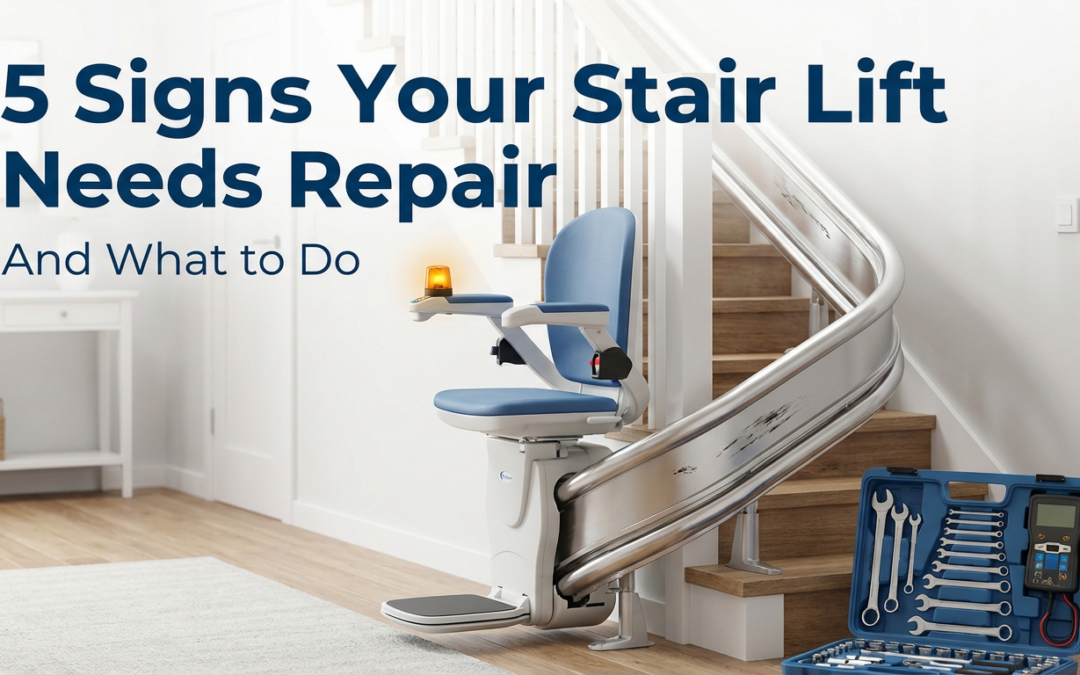
This guide walks you through the five signs your stair lift needs repair, what each symptom means, and exactly what to do when you spot them. If you’re searching for stair lift repair near me, start here before you call.
Sign 1: Unusual Noises During Operation
A healthy stair lift runs quietly. You should hear a smooth, low hum from the motor and the gentle click of the seat locking into position. When that changes, pay attention.
What to listen for:
- Grinding or scraping sounds from the motor housing
- Squealing from the track during ascent or descent
- Clicking, popping, or rattling that wasn’t there before
- Sudden loud noises when starting or stopping
What it usually means:
Most noise issues trace back to three causes: worn gears in the motor, debris or damage on the track, or failing bearings in the carriage. Colorado’s dry climate and dust can accelerate wear on moving parts. I’ve found everything from accumulated pet hair to cracked track sections causing these sounds.
What to do:
Don’t wait. Unusual noises rarely resolve themselves. Call for stair lift repair in Colorado as soon as you notice the change. Continuing to use a noisy lift can turn a $200 gear adjustment into a $2,000 motor replacement. At Independent Living Solutions, Chase can typically diagnose noise issues within minutes of arrival.
Sign 2: Jerky Movement, Hesitation, or Speed Changes
Your stair lift should move at a consistent, steady pace. If it’s speeding up, slowing down, or stopping mid-ride, something is wrong.
What to watch for:
- The lift pauses briefly during travel, then resumes
- Noticeable speed variation between floors
- Sudden stops that require resetting
- Rough or vibrating movement that wasn’t present before
What it usually means:
Jerky operation usually indicates electrical issues – failing batteries, loose wiring connections, or a dying circuit board. In Colorado, power fluctuations from winter storms can stress electrical components. Battery-powered lifts, such as the Savaria models we install, are designed for outage protection, but batteries degrade over time.
What to do:
Document when the hesitation happens. Is it at a specific point on the track? After the lift has been idle? During cold weather? This information helps Chase diagnose faster. Most electrical repairs are straightforward: battery replacement, connection tightening, or circuit board swap, but they require a technician. Don’t attempt electrical work yourself.
Sign #3: The Lift Won’t Start or Respond to Controls
You press the button. Nothing happens. Or the lift starts, then stops immediately. This is the failure mode everyone fears, and it’s more common than it should be.
What to check first:
- Is the lift plugged in? (Surprisingly often, the answer is no — vacuuming, cleaning, or pets can dislodge cords)
- Is the key switch in the “on” position? (Many lifts have a key lock for safety)
- Are the armrests fully lowered? (Lifts won’t operate unless seated properly)
- Is the battery indicator showing a charge?
What it usually means:
If basic checks don’t solve it, you’re likely looking at: dead batteries, a failed charger, a broken safety switch, or a seized motor. Sometimes it’s a simple fix—I’ve restored service by reconnecting a single wire. Other times, components have reached end-of-life and need replacement.
What to do:
Run through the checklist above. If the lift still won’t respond, call for stair lift repair near me immediately. A non-functioning lift isn’t just inconvenient; it can trap someone upstairs or downstairs. We prioritize these calls and often provide same-day service for complete failures.
Sign 4: The Track Feels Loose or the Seat Wobbles
Physical instability is never normal. Your stair lift should feel solid, secure, and predictable every time you sit down.
What to check:
- Does the seat shift or rock when you sit?
- Can you move the track by hand? (You shouldn’t be able to)
- Are there visible gaps between the rail and the stairs?
- Does the footrest droop or fail to stay in position?
What it usually means:
Loose components indicate installation issues, worn brackets, or structural problems. Sometimes the original installer didn’t anchor properly to the stair treads. Sometimes, years of vibration have loosened hardware. Occasionally, the stairs themselves have shifted—common in Colorado’s expansive clay soils.
What to do:
Stop using the lift immediately. Instability is a safety hazard. A wobbling seat can lead to falls; a loose track can derail the carriage. This isn’t a DIY fix. Improper tightening can strip threads or crack components. Call for professional stair lift repair in Colorado. Chase will inspect every anchor point, torque specifications, and structural integrity before clearing the lift for use.
Sign 5: Error Codes, Beeping, or Warning Lights
Modern stair lifts communicate when something’s wrong. Don’t ignore them.
What to watch for:
- Flashing LED lights on the control panel
- Audible beeping patterns (often repeating sequences)
- Displayed error codes (numbers or letters)
- Constant beeping when the lift is parked
What it usually means:
Error codes are diagnostic tools. Common triggers include: obstruction sensors activated, battery charging failures, overload conditions, or internal safety system faults. That constant beeping you hear? It’s usually the lift telling you it can’t charge properly, often because the park position isn’t aligned with the charging strip.
What to do:
Check your user manual for error code meanings. If you don’t have it, most manufacturers publish them online. Note the exact pattern: flashing red twice, then solid green, for example. This information gets Chase to the right fix faster. For stair lift repair cost efficiency, accurate diagnosis matters.
What Stair Lift Repair Cost Actually Looks Like
I believe in transparent pricing. Here’s what stair lift repair costs typically range for Colorado homeowners:
| Repair Type |
Common Causes |
Estimate Range |
Timeline |
| Battery replacement |
Worn batteries, charging issues |
Lower Range |
Same day |
| Track cleaning/adjustment |
Debris buildup, minor misalignment |
Lower Range |
1-2 hours |
| Electrical repair |
Wiring, switches, circuit boards |
Mid Range |
2-4 hours |
| Motor or gearbox work |
Worn gears, bearing failure |
Higher Range |
May require parts order |
| Complete component replacement |
End-of-life major parts |
Higher Range |
1-2 days, if parts are in stock |
The only way to know your specific stair lift repair cost is with an in-home evaluation. I don’t guess over the phone. Chase diagnoses the actual problem, quotes the exact fix, and completes most repairs in a single visit. Our local warehouse stocks common parts for the brands we service, such as Handicare, Harmar, Savaria, and others.
We also service lifts we didn’t install. About half of our repair calls are for equipment installed by other companies or purchased online. We’ll fix what we can, and if we can’t (if parts are obsolete or the lift is unsafe), we’ll tell you honestly and discuss replacement options.
The Preventive Maintenance: The Repair You Avoid
Most expensive repairs are preventable. That’s why we offer Preventive Maintenance and Service Plans for Colorado homeowners.
What maintenance includes:
- Annual inspection of all mechanical and electrical components
- Track cleaning and lubrication
- Battery testing and replacement before failure
- Safety sensor calibration
- Hardware torque checks
- Control function testing
What it costs:
Less than one emergency repair call per year. For customers with limited mobility who depend on their lift daily, this is inexpensive insurance against being stranded.
During maintenance visits, Chase often spots wear before it causes failure. A gear showing early wear. A battery holding less charge. A track section is starting to separate. Fixing these early keeps your lift running and keeps stair lift repair costs manageable.
Why Local Service Matters for Stair Lift Repair Near You
When your lift stops working, you need help today—not next week. That’s why searching for “stair lift repair near me” matters.
National retailers and online sellers don’t have Chase. They don’t have a Wheat Ridge warehouse stocked with parts. They don’t have 20 years of Colorado-specific experience with the issues our climate and power grid create.
At Independent Living Solutions, we’re local. Same-day service calls happen because we’re actually here, not routing you to a contractor network. We know Denver homes, Colorado Springs layouts, Evergreen’s steep staircases, and the specific challenges of Front Range mobility equipment.
Our repairs are backed by our 1-year labor warranty. If we fix it and the same issue returns, we make it right.
When Repair Isn’t The Right Choice
Sometimes I tell customers not to repair. It sounds bad for business, but it’s essential for trust.
Consider replacement instead when:
- The lift is over 15 years old, and major components are failing
- Parts are obsolete and unavailable
- Multiple systems are failing simultaneously
- The original installation was substandard and unsafe
- Repair costs exceed 50% of replacement value
In these cases, we discuss options: new straight stair lifts ($4,100–$4,900 installed), recycled units ($2,900–$3,700), or whether a different solution, like a vertical lift, makes more sense. Our buy-back program applies if you have equipment to trade in.
If your lift is showing any of the five signs above, or if something just feels off, don’t wait for complete failure. A quick call can prevent a crisis.
Call (303) 463-8200 for “stair lift repair near me” in Denver, Colorado Springs, Evergreen, Wheat Ridge, and surrounding Front Range communities. Chase and I typically schedule within a few days for non-urgent issues and prioritize complete failures same-day when possible. We’ll diagnose, quote, and repair— honestly and efficiently.
Learn more about our stair lift services.
FAQs
Q: How much does stair lift repair cost in Colorado?
It depends on the specific issue. Simple repairs, such as battery replacement or track adjustment, are at the lower end. Motor or gearbox work costs more. The only accurate stair lift repair cost comes from an in-home diagnosis. I don’t guess over the phone. Chase and I evaluate the actual problem and give you exact pricing before any work begins.
Q: Do you repair stair lifts from other companies?
Yes. About half of our repair calls are for lifts we didn’t install. We service Handicare, Harmar, Savaria, and most other major brands. If we can fix it safely and economically, we will. If parts are obsolete or the lift is beyond repair, we’ll tell you honestly and discuss replacement options.
Q: How quickly can you respond to a repair call?
For complete failures where someone is stranded, we prioritize same-day service when possible. For non-urgent issues like unusual noises or minor hesitation, we typically schedule within a few days. Being local to Wheat Ridge with a stocked warehouse lets us respond faster than national companies.
Q: Is it worth repairing an old stair lift, or should I replace it?
Depends on age, condition, and repair scope. If the lift is under 10 years old and needs minor work, repair usually makes sense. If it’s over 15 years old with major component failure, replacement is often more economical long-term. I’ll give you an honest assessment and I’d rather earn your trust with the right recommendation than charge for a repair that won’t last.