Every week, someone asks me: “Gary, should I go with wood or aluminum?” And honestly? Most of the time, they’ve already made up their mind before they walk in the door. They’ve priced out lumber at Home Depot, or their neighbor built a wooden ramp ten years ago, and it “worked fine.”
But here’s the thing, Colorado isn’t like most places. Our freeze-thaw cycles will split wood wide open. Our UV exposure at 5,280 feet will warp boards in two seasons. And that neighbor’s ramp? I’d bet money it’s rotting at the posts right now.
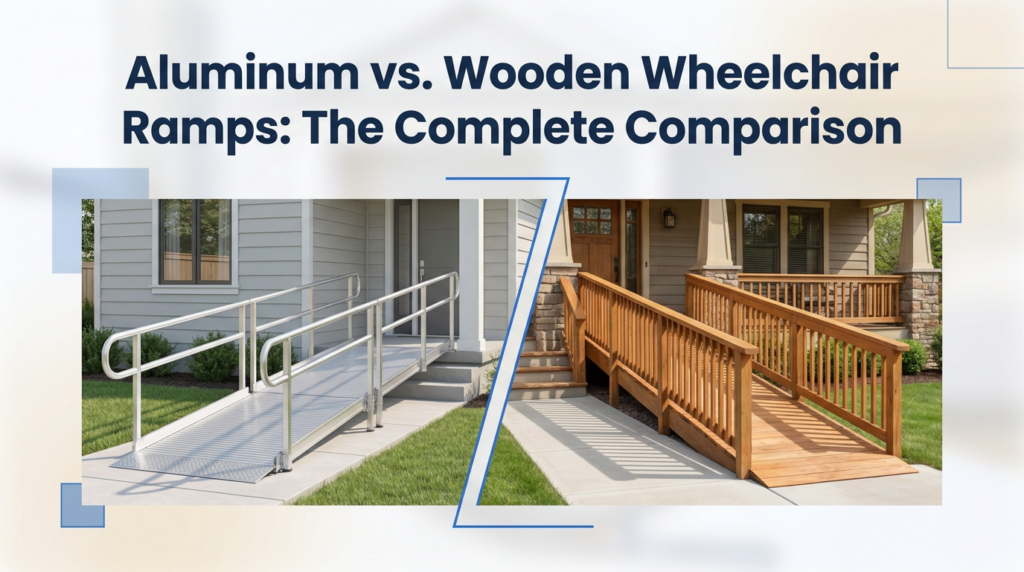
So let’s actually compare aluminum vs wooden ramp options. Not theoretically or based on what looks nice in a Pinterest photo. But based on what Chase and I have pulled out of Colorado backyards after three winters, and what we’ve installed that still looks brand new after eight years.
The Real Cost Nobody Talks About
People love telling me wood is cheaper. And sure, if you’re just looking at Day One receipts, a pressure-treated lumber ramp costs less than any modular aluminum. But that’s not the full math.
Wood needs sealing. Every year. Sometimes twice a year if it’s getting heavy sun or snow melt. It needs staining, inspecting for rot, replacing warped boards, and re-anchoring posts that have heaved in our expansive clay soils. Over five years, that “cheap” wooden ramp usually costs more in maintenance than the cost to install in the first place.
With an aluminum vs. a wooden ramp, aluminum wins on lifetime cost every single time. No sealing, staining, or rot. No termites or splinters catching wheelchair tires or walker tips. The surface stays non-slip even when icy. And if your needs change — say your mom recovers from surgery and doesn’t need the ramp anymore—we can disassemble it in a few hours, and it’s like it was never there. Try that with a poured concrete footer and 4×4 posts.
We carry both new and recycled aluminum systems, and pre-owned ramps when available. Our buy-back program means if you don’t need it anymore, you’re not stuck with a permanent structure you paid someone to build.
What Colorado Weather Actually Does to Ramps
This is where the aluminum vs wooden ramp conversation gets real. I’ve been called out to homes in Evergreen where wooden ramps are literally pulling away from the house because the posts heaved through three freeze-thaw cycles. I’ve seen Denver bungalows where the ramp surface turned into a ski slope because boards warped upward at the edges. I’ve seen railings come loose because the wood expanded and contracted until the lag bolts stripped out.
Aluminum doesn’t do that. It expands and contracts minimally. It doesn’t absorb moisture, so it doesn’t rot. It doesn’t split when water freezes in cracks because there are no cracks for water to enter. The powder-coated finish handles UV without chalking or fading. And the weight capacity? Commercial-grade aluminum systems handle 800+ pounds without flexing.
The only time I recommend wood is when someone is building new construction and wants the ramp permanently integrated into the architecture. Even then, I tell them to budget for replacement in 7–10 years. Most people don’t want to hear that.
Installation Reality: Two Very Different Experiences
Here’s what happens when you choose wood. You find a contractor. They dig footers, pour concrete, wait for the concrete to cure, frame the ramp, deck it, install railings, and you’re looking at a minimum of a week. Maybe two if the weather doesn’t cooperate. Permits are usually required because it’s a permanent structure. Inspections. Delays.
With modular aluminum, Chase and I typically install in one to two days. No concrete footers. No permits in most Front Range jurisdictions because the system isn’t permanently affixed. We anchor to your existing entryway or use adjustable support legs that sit on ground-level pads. If your soil shifts, we adjust. If you move, we take it with you.
When families ask about aluminum vs wooden ramp installation, I usually ask them one question: Do you want this solved by Friday, or do you want to manage a construction project?
Safety Features That Actually Matter
Wooden ramps can be built safely. I’ve seen some solid ones. But they rely entirely on the builder’s skill and the homeowner’s vigilance. Is the slope exactly 1:12? Did they install edge protection so wheelchair casters don’t slip off? Are the railings continuous and at the right height? Is the surface still non-slip after two years of sun exposure?
Modular aluminum ramps are engineered to ADA specifications. The slope is built into the design. Railings are integrated, not added on. The surface is extruded with a permanent non-slip texture. Transition plates eliminate the bump at the threshold. And because every section is factory-built, there’s no variance in quality between one installation and the next.
Chase checks every connection with a torque wrench. Every landing is level. Every slope is verified with a digital level. I don’t leave an installation until I’d roll my own mother down that ramp.
Flexibility: The Feature Nobody Thinks About Until They Need It
Life changes. I’ve had customers call six months after installation because their parent passed, or because they recovered from a hip replacement faster than expected, or because they’re selling the house and the buyers don’t want a ramp in the front yard.
With wood, you’re demoing. Cutting. Hauling. Repairing landscaping. Maybe patching concrete where posts were set.
With aluminum, Chase and I come back, break it down in a few hours, and your entryway looks like it did before. If you bought it, we can buy it back through our program. If you rented it for short-term recovery, we will just pick it up. No mess and no permanent alteration to your property.
This is the part of the aluminum vs wooden ramp that doesn’t get enough attention. You’re not just choosing a material. You’re choosing whether this decision is reversible.
When Wood Actually Makes Sense
I’ll be honest, there are times I don’t argue with wood. If you’re a contractor building a custom home for a wheelchair user and the ramp is part of the architectural design, integrated landscaping, intended to be permanent? Sure. Build it right, use composite decking instead of pressure-treated, and budget for maintenance.
If you’re handy, have time, and genuinely enjoy home projects? A wooden ramp can work. But go in knowing it’s not a one-and-done. It’s ongoing.
For everyone else, the family scrambling after a hospital discharge, the adult child trying to get Mom home from rehab, the homeowner who needs safe access before the next snowstorm—aluminum modular is the practical choice. It’s not about what’s theoretically possible. It’s about what actually works in real Colorado conditions with real-time constraints.
Get the Right Ramp for Your Colorado Home
If you’re weighing aluminum vs wooden ramp options for your entryway, the best next step is a free in-home assessment. No pressure. No commitment. I’ll come and measure your rise, evaluate your space, and show you exactly how a modular aluminum system would work for your specific layout.
You can see the materials in person at our showroom in Wheat Ridge – 6225 W. 48th Ave. #108. Sit in a wheelchair and roll over the surface. Feel the difference between a properly engineered system and what you’d get from a lumber yard.
Learn more about our ramp solutions and request your free assessment at Independent Living Solutions. Or call us directly at (303) 463-8200 or email info@independentlivingsolutionsinc.com.
We typically schedule within a few days, and most installations are complete within a week of assessment. If you’re facing an urgent situation, such as hospital discharge, impending weather, or a safety concern, let us know, and we’ll prioritize.
FAQ’s
Is aluminum really better than wood for Colorado’s climate?
For most homeowners, yes. I’ve pulled rotted wooden ramps out of backyards in Wheat Ridge that looked fine from the driveway. Water gets in, freezes, expands, and suddenly your posts are loose. Aluminum doesn’t absorb water, doesn’t split, and doesn’t care about UV at 5,000 feet. I’ve got aluminum ramps we installed eight years ago that still look new. Wood? You’re sealing it every year and hoping.
How much does aluminum ramp installation cost compared to wood?
Wood’s cheaper day one, no argument there. But call me in five years when you’ve stained it three times, replaced two warped boards, and paid a guy to re-anchor the posts after they heaved. Aluminum costs more upfront, but you stop thinking about it. I can give you real numbers for both. Just need to measure your rise and see your layout. Call for a free assessment, no pressure.
Can you remove an aluminum ramp if we don’t need it later?
Yes, we can. That’s actually why a lot of families go aluminum. Mom’s done with rehab, or Dad’s moved to assisted living, or you’re selling the house – Chase and I come out, break it down in a few hours, your entryway looks like it was never there. Try that with a wood ramp sunk in concrete footers. We also buy back equipment if you purchased it and don’t need it anymore.
Do aluminum ramps get slippery in snow or ice?
Everything’s slippery if you let ice build up. But the aluminum surface we use has a built-in grip texture. It’s part of the extrusion, not a coating that wears off. Wood gets slick when it’s wet, and I’ve seen mold make it worse. Keep your ramp clear of snow, same as your driveway, and aluminum handles Colorado winters better than anything else I’ve installed.