by Gary | May 19, 2026 | Wheelchair Ramps
Every week, someone asks me: “Gary, should I go with wood or aluminum?” And honestly? Most of the time, they’ve already made up their mind before they walk in the door. They’ve priced out lumber at Home Depot, or their neighbor built a wooden ramp ten years ago, and it “worked fine.”
But here’s the thing, Colorado isn’t like most places. Our freeze-thaw cycles will split wood wide open. Our UV exposure at 5,280 feet will warp boards in two seasons. And that neighbor’s ramp? I’d bet money it’s rotting at the posts right now.
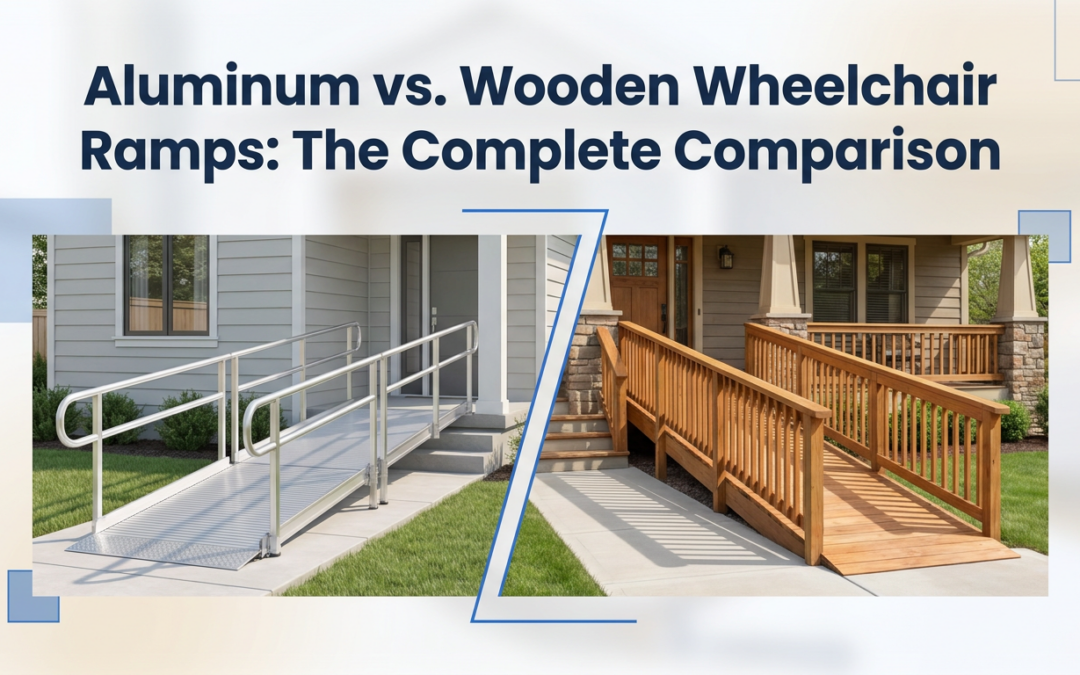
So let’s actually compare aluminum vs wooden ramp options. Not theoretically or based on what looks nice in a Pinterest photo. But based on what Chase and I have pulled out of Colorado backyards after three winters, and what we’ve installed that still looks brand new after eight years.
The Real Cost Nobody Talks About
People love telling me wood is cheaper. And sure, if you’re just looking at Day One receipts, a pressure-treated lumber ramp costs less than any modular aluminum. But that’s not the full math.
Wood needs sealing. Every year. Sometimes twice a year if it’s getting heavy sun or snow melt. It needs staining, inspecting for rot, replacing warped boards, and re-anchoring posts that have heaved in our expansive clay soils. Over five years, that “cheap” wooden ramp usually costs more in maintenance than the cost to install in the first place.
With an aluminum vs. a wooden ramp, aluminum wins on lifetime cost every single time. No sealing, staining, or rot. No termites or splinters catching wheelchair tires or walker tips. The surface stays non-slip even when icy. And if your needs change — say your mom recovers from surgery and doesn’t need the ramp anymore—we can disassemble it in a few hours, and it’s like it was never there. Try that with a poured concrete footer and 4×4 posts.
We carry both new and recycled aluminum systems, and pre-owned ramps when available. Our buy-back program means if you don’t need it anymore, you’re not stuck with a permanent structure you paid someone to build.
What Colorado Weather Actually Does to Ramps
This is where the aluminum vs wooden ramp conversation gets real. I’ve been called out to homes in Evergreen where wooden ramps are literally pulling away from the house because the posts heaved through three freeze-thaw cycles. I’ve seen Denver bungalows where the ramp surface turned into a ski slope because boards warped upward at the edges. I’ve seen railings come loose because the wood expanded and contracted until the lag bolts stripped out.
Aluminum doesn’t do that. It expands and contracts minimally. It doesn’t absorb moisture, so it doesn’t rot. It doesn’t split when water freezes in cracks because there are no cracks for water to enter. The powder-coated finish handles UV without chalking or fading. And the weight capacity? Commercial-grade aluminum systems handle 800+ pounds without flexing.
The only time I recommend wood is when someone is building new construction and wants the ramp permanently integrated into the architecture. Even then, I tell them to budget for replacement in 7–10 years. Most people don’t want to hear that.
Installation Reality: Two Very Different Experiences
Here’s what happens when you choose wood. You find a contractor. They dig footers, pour concrete, wait for the concrete to cure, frame the ramp, deck it, install railings, and you’re looking at a minimum of a week. Maybe two if the weather doesn’t cooperate. Permits are usually required because it’s a permanent structure. Inspections. Delays.
With modular aluminum, Chase and I typically install in one to two days. No concrete footers. No permits in most Front Range jurisdictions because the system isn’t permanently affixed. We anchor to your existing entryway or use adjustable support legs that sit on ground-level pads. If your soil shifts, we adjust. If you move, we take it with you.
When families ask about aluminum vs wooden ramp installation, I usually ask them one question: Do you want this solved by Friday, or do you want to manage a construction project?
Safety Features That Actually Matter
Wooden ramps can be built safely. I’ve seen some solid ones. But they rely entirely on the builder’s skill and the homeowner’s vigilance. Is the slope exactly 1:12? Did they install edge protection so wheelchair casters don’t slip off? Are the railings continuous and at the right height? Is the surface still non-slip after two years of sun exposure?
Modular aluminum ramps are engineered to ADA specifications. The slope is built into the design. Railings are integrated, not added on. The surface is extruded with a permanent non-slip texture. Transition plates eliminate the bump at the threshold. And because every section is factory-built, there’s no variance in quality between one installation and the next.
Chase checks every connection with a torque wrench. Every landing is level. Every slope is verified with a digital level. I don’t leave an installation until I’d roll my own mother down that ramp.
Flexibility: The Feature Nobody Thinks About Until They Need It
Life changes. I’ve had customers call six months after installation because their parent passed, or because they recovered from a hip replacement faster than expected, or because they’re selling the house and the buyers don’t want a ramp in the front yard.
With wood, you’re demoing. Cutting. Hauling. Repairing landscaping. Maybe patching concrete where posts were set.
With aluminum, Chase and I come back, break it down in a few hours, and your entryway looks like it did before. If you bought it, we can buy it back through our program. If you rented it for short-term recovery, we will just pick it up. No mess and no permanent alteration to your property.
This is the part of the aluminum vs wooden ramp that doesn’t get enough attention. You’re not just choosing a material. You’re choosing whether this decision is reversible.
When Wood Actually Makes Sense
I’ll be honest, there are times I don’t argue with wood. If you’re a contractor building a custom home for a wheelchair user and the ramp is part of the architectural design, integrated landscaping, intended to be permanent? Sure. Build it right, use composite decking instead of pressure-treated, and budget for maintenance.
If you’re handy, have time, and genuinely enjoy home projects? A wooden ramp can work. But go in knowing it’s not a one-and-done. It’s ongoing.
For everyone else, the family scrambling after a hospital discharge, the adult child trying to get Mom home from rehab, the homeowner who needs safe access before the next snowstorm—aluminum modular is the practical choice. It’s not about what’s theoretically possible. It’s about what actually works in real Colorado conditions with real-time constraints.
Get the Right Ramp for Your Colorado Home
If you’re weighing aluminum vs wooden ramp options for your entryway, the best next step is a free in-home assessment. No pressure. No commitment. I’ll come and measure your rise, evaluate your space, and show you exactly how a modular aluminum system would work for your specific layout.
You can see the materials in person at our showroom in Wheat Ridge – 6225 W. 48th Ave. #108. Sit in a wheelchair and roll over the surface. Feel the difference between a properly engineered system and what you’d get from a lumber yard.
Learn more about our ramp solutions and request your free assessment at Independent Living Solutions. Or call us directly at (303) 463-8200 or email info@independentlivingsolutionsinc.com.
We typically schedule within a few days, and most installations are complete within a week of assessment. If you’re facing an urgent situation, such as hospital discharge, impending weather, or a safety concern, let us know, and we’ll prioritize.
FAQ’s
Is aluminum really better than wood for Colorado’s climate?
For most homeowners, yes. I’ve pulled rotted wooden ramps out of backyards in Wheat Ridge that looked fine from the driveway. Water gets in, freezes, expands, and suddenly your posts are loose. Aluminum doesn’t absorb water, doesn’t split, and doesn’t care about UV at 5,000 feet. I’ve got aluminum ramps we installed eight years ago that still look new. Wood? You’re sealing it every year and hoping.
How much does aluminum ramp installation cost compared to wood?
Wood’s cheaper day one, no argument there. But call me in five years when you’ve stained it three times, replaced two warped boards, and paid a guy to re-anchor the posts after they heaved. Aluminum costs more upfront, but you stop thinking about it. I can give you real numbers for both. Just need to measure your rise and see your layout. Call for a free assessment, no pressure.
Can you remove an aluminum ramp if we don’t need it later?
Yes, we can. That’s actually why a lot of families go aluminum. Mom’s done with rehab, or Dad’s moved to assisted living, or you’re selling the house – Chase and I come out, break it down in a few hours, your entryway looks like it was never there. Try that with a wood ramp sunk in concrete footers. We also buy back equipment if you purchased it and don’t need it anymore.
Do aluminum ramps get slippery in snow or ice?
Everything’s slippery if you let ice build up. But the aluminum surface we use has a built-in grip texture. It’s part of the extrusion, not a coating that wears off. Wood gets slick when it’s wet, and I’ve seen mold make it worse. Keep your ramp clear of snow, same as your driveway, and aluminum handles Colorado winters better than anything else I’ve installed.

by Chase | Jan 19, 2026 | Wheelchair Ramps
In my work installing wheelchair ramps across the Front Range, the most common mistake I see on DIY and contractor-built ramps is slope. They’re built too steeply. The user can get up, but they can’t get back down safely — or a caregiver can barely control the wheelchair on the descent. Getting the slope right is not complicated, but it requires knowing the standard.
This guide covers the ADA specifications that apply to wheelchair ramps, what they mean in practice for Colorado homeowners, and what our climate adds to the picture.
Accessibility at home is not just about convenience—it’s about safety, independence, and confidence in everyday movement. For many families across Colorado, navigating steps, raised entryways, or uneven walkways can quickly become a daily challenge. As mobility needs change, homeowners are increasingly seeking solutions that enable loved ones to move freely and safely within their own space.
ADA Wheelchair Ramp Specifications — Complete Reference Table
|
ADA specification
|
Requirement
|
What it means in practice
|
|
Running slope (rise:run)
|
Maximum 1:12 (8.33%)
|
For every 1 inch of rise, you need at least 12 inches of ramp length
|
|
Cross slope (side to side)
|
Maximum 1:48 (2%)
|
Prevents wheelchair drifting sideways — important on CO hillside properties
|
|
Minimum clear width
|
36 inches between handrails
|
Power chairs and scooters benefit from 42–48 inches where space allows
|
|
Maximum rise per run
|
30 inches vertical
|
A landing is required after every 30 inches of vertical rise
|
|
Landing dimensions
|
60 × 60 inches minimum
|
Required at top, bottom, and any turn or intermediate level
|
|
Handrail height
|
34–38 inches above ramp surface
|
Required on both sides when total rise exceeds 6 inches
|
|
Handrail extensions
|
12 inches beyond top and bottom
|
Allows user to stabilise before stepping off ramp surface
|
|
Edge protection
|
2-inch minimum raised curb or rail
|
Prevents wheelchair wheels drifting off the ramp edge
|
|
Surface requirement
|
Stable, firm, and slip-resistant
|
Aluminium textured surface meets this in all Colorado weather conditions
|
These specifications apply to commercial and public-use spaces under ADA law. For residential ramps, compliance is not legally mandated — but these standards represent best practice for safety and usability. We build all our residential ramps to ADA specifications as standard.
Why Colorado’s Climate Adds to These Requirements
Freeze-thaw cycles
The Front Range experiences dramatic temperature swings — 40°F or more in a single day during spring and autumn. Wood ramps absorb moisture, expand and contract with temperature changes, and over 2–3 Colorado winters, the structure shifts and the surface grip fails. Aluminium does not absorb moisture, does not expand and contract in the same way, and maintains its structural integrity through Colorado’s seasonal cycles.
UV exposure at altitude
Denver sits at 5,280 feet, and mountain communities are significantly higher. UV intensity at altitude degrades rubber edge strips, painted surfaces, and cheaper composite materials faster than at sea level. The aluminium ramp systems we install use UV-stable coatings that hold up under Colorado’s UV load without fading or becoming slippery.
Snow and ice clearance
A ramp covered in snow or ice is a safety hazard regardless of slope. The textured aluminium surface we use maintains grip when wet. You can clear it with a standard plastic snow shovel or brush without damaging the surface — which is not true of wood ramps. We also position ramps to maximise solar exposure where possible, which helps the surface clear faster.
Wind load in mountain communities
Properties above 6,000 feet can face elevated wind conditions. Our modular ramp systems are anchored specifically for the site conditions at your property. Mountain community installs include wind load assessment as part of the free in-home consultation.
That’s where ramps for wheelchair and mobility scooter access play a critical role. A properly designed ramp can transform a home, allowing wheelchair users and scooter users to enter, exit, and move around with ease, without relying on assistance or temporary fixes.
Understanding safety standards is essential before installing a ramp, especially for homeowners considering long-term accessibility improvements in Colorado.
Why Wheelchair Ramps Are Essential for Colorado Homes
Many Colorado homes are built with elevation changes, steps at entrances, or garages positioned above ground level. While these designs work well for able-bodied individuals, they can pose significant challenges for those using wheelchairs or scooters.
Professionally designed wheelchair ramps that Colorado homeowners install help remove these barriers by creating a smooth, stable transition between levels. Whether used daily or occasionally, ramps provide dependable access that supports independent living.
For families relying on ramps for wheelchair and mobility scooter access, a ramp isn’t just a feature—it’s a necessary pathway that restores freedom of movement and peace of mind.
Key Safety Standards Every Homeowner Should Understand
Installing a ramp is not just about placing a surface over steps. Safety standards ensure the ramp functions properly and protects the user.
Proper Slope and Incline
A ramp’s slope directly affects usability. Ramps that are too steep can be difficult or unsafe to navigate, especially for manual wheelchairs or mobility scooters. A gradual incline allows for controlled movement and reduces the risk of tipping or fatigue.
Homes using ramps for wheelchair and mobility scooter access benefit from slopes designed to accommodate different mobility devices comfortably.
Adequate Width and Clearance
Ramps should provide enough width for safe navigation, including space for turning and maneuvering. Mobility scooters often require additional clearance, making proper planning essential for wheelchair ramp installations in Colorado.
Clear access points help prevent collisions with railings, walls, or door frames.
Surface Traction and Weather Considerations
Colorado’s weather can change quickly, making traction a top priority. Ramp surfaces should be designed to reduce slipping risks during rain, snow, or icy conditions. This is especially important for exterior wheelchair ramps that Colorado homeowners rely on year-round.
Entry-Level Access vs. Vertical Mobility Solutions
While ramps are ideal for many homes, certain layouts may require a vertical solution instead of a sloped pathway. In these cases, a wheelchair lift can provide safe access between levels when space is limited.
A wheelchair lift is often considered when elevation changes are significant or when installing a ramp would require excessive length. However, ramps remain a preferred solution for many homeowners because they allow continuous access without mechanical operation.
In some homes, ramps for wheelchair and mobility scooter access and a wheelchair lift may work together to create a fully accessible environment.
Permanent vs. Modular Ramp Systems
Homeowners often choose between permanent and modular ramp options based on their needs.
Permanent ramps are built for long-term use and are designed to integrate with the home’s structure. Modular ramps offer flexibility and can be adjusted or relocated if mobility needs change.
Both options can meet safety standards when installed correctly, and both are commonly used for wheelchair ramps for Colorado residents.
To explore professionally installed ramp options, visit: Independent Living Solutions’ Ramps
Planning a Safe Ramp Installation
Before installing a ramp, homeowners should consider several practical factors:
- User needs: Wheelchair type, scooter size, and level of independence
- Home layout: Entry height, available space, and walking paths
- Frequency of use: Daily access versus occasional use
- Long-term plans: Aging in place or changing mobility requirements
Professional assessment helps ensure ramps for wheelchair and mobility scooter access are safe, durable, and suited to the home’s specific layout.
How Ramps Support Independent Living
Accessibility upgrades do more than improve mobility. They support confidence and independence. When individuals can move in and out of their home without assistance, daily life becomes more predictable and less stressful.
Professionally installed wheelchair ramps that Colorado homeowners trust help reduce fall risks, improve safety for caregivers, and encourage continued independence.
For homes where ramps alone may not be sufficient, a wheelchair lift can provide additional vertical access while maintaining safety and ease of use.
Maintenance and Long-Term Safety
Once installed, ramps should be inspected regularly to ensure continued safety. Checking surface condition, handrails, and transitions helps maintain reliable access. Whether you choose permanent ramps, modular systems, or a wheelchair lift, ongoing maintenance ensures your accessibility solution continues to perform as intended. Independent Living Solutions provides guidance not only during installation but also for long-term usability and safety.
For trusted accessibility solutions, homeowners across Colorado turn to Independent Living Solutions.
Making the Right Accessibility Choice for Your Home
Every home and every mobility need is different. Choosing the right solution means balancing safety, space, and daily usability. For many families, ramps for wheelchair and mobility scooter access offer a practical, reliable way to support independence at home.
Others may find that combining wheelchair ramp installations with a wheelchair lift in Colorado provides complete accessibility across all levels of the home.
Take the Next Step Toward Safer Home Access
If you’re considering installing a ramp or exploring accessibility options, now is the time to plan ahead. Safe, professionally designed wheelchair ramps that Colorado homeowners rely on can make everyday life easier and more secure.
Independent Living Solutions offers professional guidance and installation services to help homeowners choose the right accessibility solution for their needs.
Creating a safer home starts with informed decisions, and the right accessibility partner can make all the difference!
Get a Free Ramp Assessment
Call (303) 463-8200 or email info@independentlivingsolutionsinc.com to schedule a free in-home ramp assessment. We measure your rise, assess your site, and recommend the right ramp configuration at no cost and no obligation.
|
Frequently Asked Questions
Does my residential wheelchair ramp need to be ADA compliant?
ADA compliance is technically required for commercial and public-use spaces. For residential ramps, it is not legally mandated — but ADA specifications represent best practice for safety and usability. We build all residential ramps to ADA standards.
What is the maximum slope for a wheelchair ramp in Colorado?
The ADA maximum running slope is 1:12 (8.33%). For power wheelchairs and scooters, we recommend 1:16 or gentler where space allows — steeper slopes are tiring for manual wheelchair users and can be difficult to control on the descent.
How wide should a residential wheelchair ramp be?
The ADA minimum is 36 inches of clear width between handrails. We recommend 42–48 inches for power wheelchairs and scooters, and for situations where a caregiver walks alongside the wheelchair user.
Do I need handrails on both sides of a residential ramp?
ADA requires handrails on both sides when the total rise exceeds 6 inches. For residential use, we install handrails on both sides as standard for any ramp over 3 inches rise — it is simply safer, particularly for elderly users and in icy Colorado conditions.