
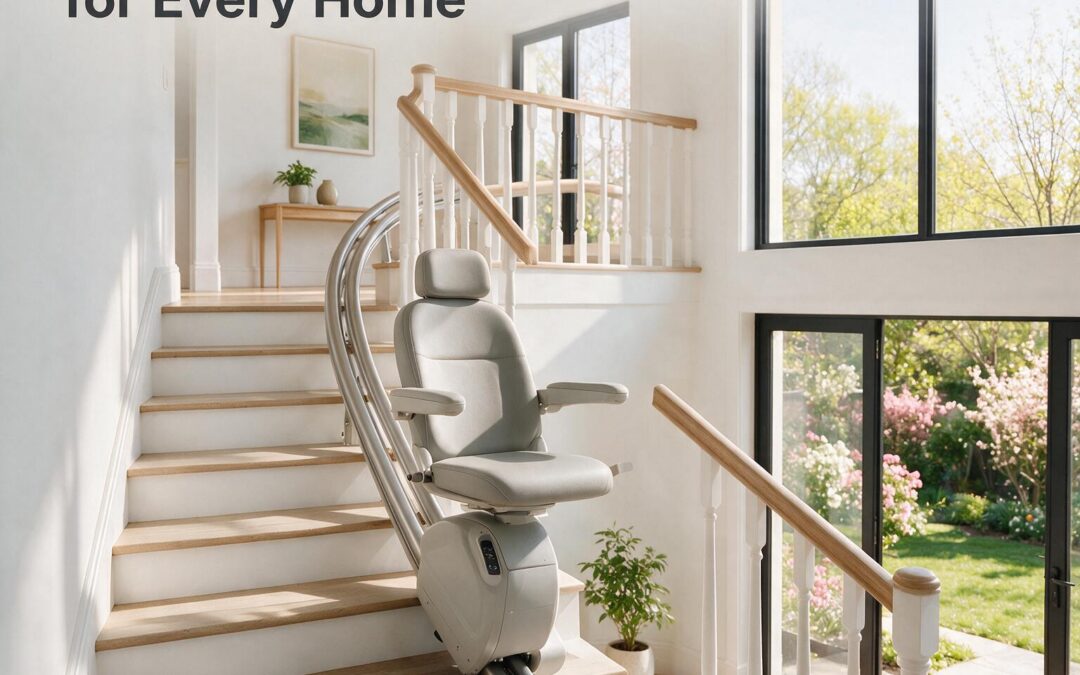
The first thing I do when I walk into a home with a curved staircase is look at it carefully before I say anything. Some of these staircases were built a hundred years ago by craftsmen who took real pride in the geometry. A graceful sweep up to the second floor, a tight spiral in a Capitol Hill Victorian, a switchback with a carved newel post that the homeowner’s grandmother picked out in 1952. These aren’t just functional structures. They’re part of the home.
I say this because the families who call us about curved residential chair lifts are sometimes braced for bad news. They’ve been told their staircase is too complicated, or the cost is too high, or it can’t be done without damaging the character of the stairs. Most of the time, that’s not true. Custom stair lifts for curved staircases in Colorado have been our specialty since we opened in 2008, and what we’ve learned is that the staircase almost always has a solution. It just takes the right process to find it.
How Curved Residential Chair Lifts Actually Work
Not a Bent Version of a Straight Rail
This is the first thing worth understanding: a curved residential chair lift is not a straight lift with a bend added. It’s a different product category with a fundamentally different manufacturing process.
A straight lift uses a standard rail cut to length and adjusted for the staircase angle. The rail comes from a warehouse. A curved lift uses a rail that is custom-bent, welded, and formed to follow the precise geometry of a specific staircase. That rail is fabricated specifically for your home and won’t fit any other staircase in the world. The chair on a curved system also rotates at turns to keep the user properly oriented throughout travel, which adds mechanical complexity that straight-rail systems don’t require.
What the Chair Itself Handles
The seat swivels at the top of the staircase to allow safe dismount. Footrests and armrests fold to keep the staircase usable by other household members when the lift is parked. Controls are typically joystick-operated at the chair and also include remote call and send functions so the lift can be summoned from either level.
Weight capacity on standard curved units is 300 lbs. There is an option for a 350-lb weight capacity.
Staircase Types We Build Custom Rails For
The Range Is Wider Than Most Families Expect
When people hear “curved stair lift,” they often picture a single type of staircase. The reality is that custom stair lifts for curved staircases in Colorado cover a wide range of configurations, including some that feel genuinely complex until you’ve done a few of them.
- 90-degree turns. One of the most common configurations in Denver-area homes, especially post-war construction where the staircase changes direction at an intermediate point.
- 180-degree switchbacks. The second flight runs parallel to the first in the opposite direction. The rail completes a full U-turn between flights.
- Spiral staircases. Continuous curves from bottom to top. These require the most precise fabrication and the most careful installation, but they’re achievable.
- Multiple landings. Staircases that include flat transition areas between flights require a rail that follows the stairs, traverses the landing, and transitions smoothly into the next flight.
- Steep or narrow curves. Some older Colorado homes have staircases that are both curved and tight. We measure for clearance during the assessment to confirm the chair can travel without obstruction before anything is ordered.
When Straight Stair Lifts for Sale Solve Part of the Problem
There are configurations where two straight stair lifts for sale, one on each flight, with a short transfer across a landing between them, cost significantly less than a single curved system. This isn’t always practical, and it requires the user to be able to stand briefly for the transfer, but it’s worth discussing honestly during the assessment. We carry straight stair lifts for sale in stock and can often install them the same week, which matters when timing is urgent.
The Custom Planning Process: Photography, Measurement, and CAD
Why This Takes More Time Than a Straight Installation
Straight stair lift installations often happen within the same week as the assessment because we stock those units in our local warehouse. Curved lifts require a different timeline, and understanding why helps families plan without frustration.
The process for a curved installation looks like this:
- Free in-home assessment. We visit the home, walk up the staircase, and discuss what the person needs. No commitment required.
- Photography and detailed measurement. We document every dimension: tread depth, riser height, angles at each turn, landing widths in configurations with multiple landings, ceiling clearance, and distance to power sources.
- CAD rail design. The measurements go to the manufacturer, who produces a CAD drawing of the proposed rail geometry.
- Homeowner approval. We share the drawing with the homeowner for review before fabrication begins. This step prevents surprises at installation.
- Custom fabrication. The rail is bent and welded to the approved specifications. This is where the lead time comes from. Precision fabrication takes time.
- Installation. A technician mounts the rail to the stair treads, not the walls, fits the chair system, and runs the full travel path to check alignment.
- Testing and training. Every installation is tested under load and every user is trained on operation, parking positions, and safety features before we leave.
The one-year labor warranty on new installations covers this full process. Manufacturer warranties extend coverage for equipment issues beyond that period. Service plans are available for families who want scheduled annual maintenance going forward.
Installation Best Practices: Protecting the Staircase
The Rail Mounts to the Treads, Not the Walls
The most common concern we hear from families with architecturally significant staircases is damage. They don’t want brackets in the plaster, holes in the wainscoting, or anything that compromises the staircase they’ve lived with for decades.
The rail system mounts to the stair treads. That’s the correct installation method regardless of staircase style, and it means the walls are untouched. The tread fasteners are appropriate for the tread material, whether that’s hardwood, carpet over wood, or another surface. If the lift is ever removed, the tread fasteners come out, and the staircase is structurally unchanged.
Curved installations take six to ten hours on installation day. The house stays functional throughout. We don’t need to close off rooms or move furniture on other floors.
Curved Stair Lift Repair in Colorado: What Happens After Installation
Why Local Service Matters More for Curved Systems
Curved stair lift repair in Colorado is not the same as repairing a straight unit. The rail is unique to the staircase. A technician who hasn’t seen the system before needs to understand the specific geometry before diagnosing any issue. Remote troubleshooting from a national call center has real limitations here.
We provide local service across the Front Range and surrounding communities, which means the technician who comes for a repair call is familiar with the brands we install and can work from the installation documentation we keep on file.
Common Issues That Come Up Over Time
- Rail alignment. Homes settle. Temperature cycles through Colorado winters can cause minor shifts. Annual service catches alignment issues before they become operational problems.
- Battery condition. Curved lifts operate as battery-operated systems, which means they run independently of wall power. Batteries have a service life and should be checked and replaced on a schedule.
- Motor and drive mechanism wear. Normal use over years produces gradual wear in drive components. Scheduled maintenance identifies this before it causes a failure.
- Call station and remote function. These are the first components to show wear in high-use systems and are straightforward to service when caught early.
Cost and Value: What Curved Stair Lifts Actually Cost in Colorado
Honest Numbers
Curved stair lift installations start around $14,000 installed. Price increases from there based on staircase complexity, rail length, number of turns, and any specialized configuration requirements. These are installed prices, meaning measurement, fabrication, delivery, installation, testing, and training are all included.
That number lands differently depending on the alternative. Assisted living in Colorado costs tens of thousands of dollars per year at most facilities. Moving to a single-level home in Denver’s current market involves real estate costs, moving expenses, and the disruption of leaving a home someone has lived in for decades. For most families, the math is not close.
Your staircase shouldn’t be the reason you leave a home you love. Our team has been building and installing curved stair lift systems for Colorado homes since 2008, and we’d like to walk your staircase with you. Schedule a free in-home assessment by calling (303) 463-8200 or emailing info@independentlivingsolutionsinc.com. We serve the Front Range and surrounding Colorado communities, and the assessment costs you nothing.
Frequently Asked Questions
Can a curved stair lift be installed on a spiral staircase?
Yes. Spiral staircases are among the more complex configurations we handle, but the custom fabrication process allows the rail to follow a continuous spiral from bottom to top. The precision required is high, which is why the measurement and CAD design steps matter so much. We confirm fit before fabrication begins, so there are no surprises on installation day.
How long does a curved stair lift installation take?
Installation day typically runs six to ten hours for a curved system. That’s the time from our technician arriving to the lift being tested and the homeowner being trained on operation. The longer part of the total timeline is custom fabrication, which happens before installation day. We give families a realistic lead time at the assessment stage so they can plan appropriately.
Is it worth repairing a curved stair lift, or should I replace it?
It depends on the age of the unit, the nature of the problem, and the cost of the repair relative to replacement. Most mechanical issues, including motor wear, battery replacement, and rail alignment, are worth repairing because the custom rail itself is still sound and a replacement would require new fabrication at full cost. We assess each situation individually and give you an honest recommendation rather than defaulting to replacement.
What is the difference between a curved and a straight stair lift for Colorado homes?
A straight stair lift uses a standard rail on a single uninterrupted flight of stairs. A curved lift uses a custom-fabricated rail built for a specific staircase with turns, multiple landings, or spiral sections. Straight lifts are faster to install and lower in cost. Curved lifts require a longer lead time and a more detailed planning process, but they’re the only solution for staircases that aren’t straight. We stock straight stair lifts for sale for same-week installation in many cases, while curved systems require scheduling around the fabrication timeline.