
Enquire here
Menu
Mobility Equipment Installation in Colorado: Our Complete Guide to Safer Living

Mobility Equipment Installation in Colorado: Our Complete Guide to Safer Living

Professional mobility equipment installation in Colorado is not the same thing as delivery. When a stair lift, platform lift, or ramp system is installed by a trained technician who has measured the space, evaluated the structural requirements, and tested the equipment under load, the result is a system that works reliably and safely for years. When equipment is dropped off and assembled without that process, the outcome is unpredictable.

Colorado’s housing stock is genuinely diverse. We work in narrow Victorian row houses in Capitol Hill; sprawling ranch homes on the Eastern Plains; split-levels in Wheat Ridge; and steep-staired cabins in mountain communities above 8,000 feet. Each of those environments presents different demands. Elevation, temperature swings, older wiring, irregular stair dimensions, and nonstandard doorway widths all factor into how equipment is selected and installed.

This guide covers what types of mobility equipment we install, how our installation process works, what communities we serve, and what homeowners across Colorado should understand before starting this process. We have earned an A+ rating with the Better Business Bureau, and that reflects in our work. By the end, you will know what equipment fits your situation, what a professional installation actually involves, and why working with an experienced local team makes a practical difference.

Types of Mobility Equipment We Install

Our team at Independent Living Solutions installs a full range of residential mobility equipment throughout Colorado. We are not a single-product dealer, which matters because the right solution depends on the individual, the home, and the specific access challenge, not on what a single-category supplier can offer.

  • Straight stair lifts. Designed for staircases without turns or landings. These are the most common residential installations we complete, and new units are typically in stock in our local warehouse.
  • Curved stair lifts. Custom-fabricated for staircases with turns, bends, or intermediate landings. Each rail is built to the specific measurements of the staircase. Lead times are longer, but the result is a system designed precisely for that home.
  • Vertical platform lifts. A platform lift moves a user vertically between levels on an open platform rather than a seated chair. These are appropriate for wheelchair users and for applications where a ramp is not practical. We carry and install residential vertical platform lift systems for both interior and exterior use.
  • Handicap lifts for sale. We maintain an inventory of handicap lifts for sale at our Wheat Ridge location, including both new and certified pre-owned units. Customers can visit our showroom at 6225 W. 48th Ave. #108 to evaluate equipment in person before purchasing.
  • Modular ramp systems. Aluminum modular ramps can be configured for entryways, porches, and multi-step transitions. They are removable and do not require permanent structural changes to the home.
  • Ceiling lift systems. For transfers between bed, wheelchair, and other positions, ceiling-mounted lift systems provide safe, caregiver-supported movement without manual lifting strain.

Our full-service capability means we handle assessment, equipment selection, installation, testing, and ongoing service for all of these systems under one roof.

Our Installation Process Step by Step

Mobility equipment installation in Colorado that is done correctly follows a consistent process. Here is what that looks like with our team.

  • In-home evaluation. A member of our team visits the home, measures the relevant spaces, evaluates structural and electrical conditions, and discusses the individual’s mobility needs. No product is ordered until this step is complete. Our BBB A+ rating reflects the care we take at this stage because getting the assessment right prevents problems later.
  • Electrical requirements. Most stair lifts are battery-operated. Platform lifts may have additional electrical requirements. We identify these during the evaluation and coordinate any needed electrical preparation before installation day.
  • Consultation to completion timeline. Straight stair lift installations are typically scheduled and completed within a short window after the assessment. Curved lifts require custom fabrication, which adds lead time. We give homeowners a realistic timeline at the outset.
  • Post-installation testing. Every installation is tested fully before we leave. That includes load testing, safety sensor verification, and operation of all controls, including remote call and send functions.
  • User training. We walk the homeowner and any family members through the operation before we consider the installation complete. That includes proper use, parking positions, safety features, and how to reach us if anything needs attention.

Serving Denver and Beyond

Our showroom is in Wheat Ridge, but our service area covers communities across Colorado. Providing the mobility solutions that Denver and Front Range families depend on is central to what we do, and we extend that same service to communities well beyond the metro area.

  • Front Range communities. We regularly serve Denver, Wheat Ridge, Lakewood, Arvada, Westminster, Thornton, Aurora, Centennial, Littleton, Englewood, and surrounding areas.
  • Colorado Springs and the Pikes Peak region. El Paso County is a regular part of our service territory. We have completed installations throughout Colorado Springs and neighboring communities.
  • Mountain communities. Evergreen, Golden, Conifer, Bailey, and other foothill and mountain communities present specific installation considerations, including steeper staircases, older construction, and weather exposure that affects outdoor equipment.
  • Elevation and climate factors. Equipment selection and maintenance recommendations account for Colorado’s altitude, UV intensity, and temperature ranges. These are real variables, not theoretical ones. A battery backup that works adequately at sea level may behave differently at high elevation in cold temperatures.
  • Urban vs. rural installation challenges. Urban homes often present narrow staircases, limited parking for our service vehicles, and older electrical infrastructure. Rural properties may have longer response times for service calls, which makes choosing equipment with strong reliability records more important.

As a provider of mobility solutions that Denver and Front Range families have relied on since 2008, we understand how Colorado’s geography shapes these projects.

When to Choose a Vertical Platform Lift with Staircase Access

Not every staircase access challenge is best solved with a stair lift. A vertical platform lift with staircase access is the right answer in specific situations, and understanding those situations helps families make the right call the first time.

  • Wheelchair users. A stair lift requires the user to transfer from a wheelchair to the lift seat. For someone who cannot safely make that transfer, a vertical platform lift with staircase access provides a platform large enough to accommodate the wheelchair without any transfer required.
  • Multi-level porch access. Exterior porches with multiple steps are often impractical to ramp due to grade or space constraints. A compact vertical platform lift can provide safe vertical travel in a small footprint.
  • Space and clearance requirements. Platform lifts require adequate clearance at both the upper and lower landings. We evaluate this during the in-home assessment to confirm the system will fit before any equipment is ordered.
  • When a stair lift is the better fit. For users who can transfer safely to a seat, a stair lift is typically a more affordable and faster-to-install solution. We walk through both options during every assessment so families understand the tradeoffs.

Our inventory of handicap lifts for sale includes both stair lift and platform lift options, and we carry equipment from multiple manufacturers to ensure we can match the right product to each situation.

Safety Standards and Compliance

Mobility equipment installed in a home is not a consumer product that can be returned if it does not work right. It is a safety system. The standards that govern installation exist for that reason.

  • ANSI and ASME compliance. Stair lifts and vertical platform lifts are governed by published safety standards covering load capacity, speed, emergency stopping, and obstruction sensing. We install equipment that meets these standards and verify compliance during post-installation testing.
  • Why DIY installation creates risk. Self-installation of a stair lift or platform lift voids most manufacturer warranties and creates liability for the homeowner if an incident occurs. Beyond warranty concerns, improper rail attachment, incorrect electrical connections, and missed safety sensor calibration are real failure points that a trained technician catches and a DIY installer may not.
  • Our technicians’ qualifications. Our installation is performed by trained and certified technicians on the equipment we carry, and we do not subcontract residential mobility equipment installation in Colorado to subcontractors who are unfamiliar with these systems. Our BBB A+-accredited status since 2009 is publicly verifiable, and it reflects the consistency of our installation and service record across Colorado.

Professional Installation Is the Foundation

Safe, reliable mobility starts with professional installation done right the first time. Our team has completed mobility equipment installations across Colorado for nearly two decades, and the consistency of our process is what ensures our equipment performs as intended over the long term.

If you are ready to explore options, we offer free in-home evaluations with no obligation. Visit Independent Living Solutions to learn more about our full range of equipment and services, or reach us at (303) 463-8200 to schedule your evaluation. You can verify our A+ BBB rating at bbb.org before you schedule your free evaluation. Our showroom is located at 6225 W. 48th Ave. #108, Wheat Ridge, and we are available to answer questions by phone or email at info@independentlivingsolutionsinc.com.

Frequently Asked Questions

Q: How long does a typical stair lift installation take?
Most straight stair lift installations are completed in two to four hours. Curved stair lift installations take longer because the custom rail must be fitted and aligned to the fabricated specifications, typically six to ten hours. If electrical work is needed before installation, that may require a separate appointment or a full-day visit. We schedule installations to minimize disruption to the household and confirm the timeline with homeowners before the appointment.

Q: Can mobility equipment be installed in rental properties?
Yes, with landlord approval. Most landlords are willing to provide written consent for mobility modifications, particularly when the equipment is installed professionally and the tenant can demonstrate a medical need. We offer modular and removable options, including modular ramp systems and some stair lift configurations, that can be removed without damage to the property when the tenancy ends. We include documentation of the installation for the tenant to share with their landlord.

Q: What is the difference between a stair lift and a vertical platform lift?
A stair lift is a motorized chair that travels along a rail mounted to the staircase. The user sits in the chair and rides between floors while remaining seated. A vertical platform lift is a motorized platform that moves vertically between two levels. The user, including a wheelchair user, remains on the platform rather than transferring to a seat. Stair lifts are generally more affordable and better suited for users who can transfer independently. Platform lifts are better suited for wheelchair users or situations where transferring is not safe or practical. We assess and recommend based on the individual’s mobility needs and the layout of the home.

Regain Freedom Over Mobility & Live independently with An Efficient Mobility Scooter in Denver

Regain Freedom Over Mobility & Live independently with An Efficient Mobility Scooter in Denver

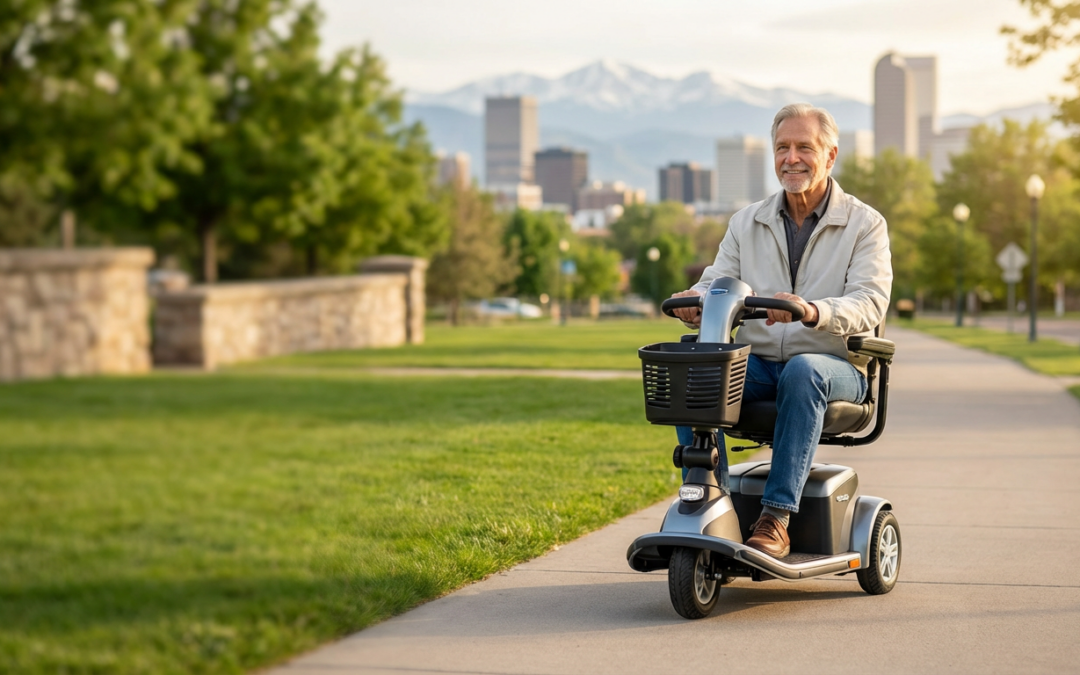
One of the most common conversations I have with Denver-area families isn’t about stair lifts or elevators. It’s about range. A parent who used to walk to the grocery store in Wheat Ridge but can’t anymore. A retiree who loves the Cherry Creek Trail but gets tired after half a block. A woman in Aurora who just wants to get to her mailbox without feeling exhausted.

A mobility scooter solves a different problem than most accessibility equipment — it extends the range of what’s possible outside the home. And Denver is a great city for scooter users: the Cherry Creek Trail, the Highline Canal Trail, the Denver Botanic Gardens, the RTD light rail stations. There is a lot to explore if you have the right equipment.

This guide covers what to look for in a mobility scooter in Denver, what they cost, and what you need to know about using one in Colorado’s specific environment.

Mobility Scooter Types and Buying Guide  

Type Speed Range Best for Price range
3-wheel travel scooter 4 mph 10–15 miles Indoor use, tight spaces, air travel disassembly $700–$2,000
4-wheel mid-size scooter 5 mph 15–25 miles Outdoor use, neighbourhood errands, Denver flat paths $1,200–$3,500
Heavy-duty outdoor scooter 6 mph 25–40 miles Longer distances, Cherry Creek Trail, uneven terrain $2,000–$5,000
Used/refurbished scooter Varies Varies Budget option, lighter daily use $400–$1,500

Using a Mobility Scooter in Denver: What You Need to Know 

Where Denver scooter users go

The Cherry Creek Trail is one of the best paths in the country for mobility scooter users, paved, flat, and well-maintained for most of its 40-mile length. The Highline Canal Trail and the Washington Park loop are also popular. The Denver Botanic Gardens has fully accessible paths. RTD light rail stations are ADA-compliant and accessible for scooter users.

Denver’s elevation and battery range

Denver sits at 5,280 feet. At altitude, electric motors work slightly harder, and battery range is typically 10–15% lower than sea-level specifications. If a scooter is rated for 25 miles at sea level, budget for 21–22 miles in Denver. Mountain communities are an even more significant factor in a 15–20% reduction above 7,000 feet.

Colorado weather considerations

Most mobility scooters are not designed for snow or standing water. During Colorado winters, plan for indoor use only during and immediately after snowfall. The 3-wheel and mid-size 4-wheel models we carry have weather-resistant electronics, but prolonged exposure to moisture is hard on any scooter’s electrical systems.

Storage and charging at home

Most Denver homes have garage access, which is ideal for storing scooters, which store best in a dry environment out of direct sun and extreme cold. Charging uses a standard 120V wall outlet. Charge overnight; most models reach full charge in 8–12 hours and should not be left plugged in for extended periods after full charge.

Transport in a vehicle

3-wheel travel scooters disassemble into 4–5 pieces (heaviest section typically 25–35 lbs) for car boot loading. 4-wheel mid-size models require a vehicle lift or ramp. At your assessment, I’ll discuss which option matches your vehicle and your physical ability to load and unload.

Medicare and Medicaid Coverage in Colorado 

Medicare Part B may cover power-operated vehicles (which include some mobility scooters) when prescribed by a physician as medically necessary for indoor mobility. Coverage criteria are specific:

  • The physician must document that you cannot perform activities of daily living without the scooter due to a mobility-limiting condition.
  • The primary intended use must be indoor mobility, not outdoor recreation.
  • You must be enrolled in Original Medicare (Part B); not all Medicare Advantage plans cover power-operated vehicles the same way.

Colorado Medicaid may also provide coverage through HCBS waivers for qualifying individuals. The process involves documentation and a physician’s prescription.

At ILS, we assist customers in preparing the documentation required for Medicare and Medicaid applications. This is part of our service — not a separate charge.

For most Denver-area users who want to use their scooter both indoors and for neighbourhood errands, the 4-wheel mid-size is the most practical choice. If air travel is planned or indoor use is the priority, the 3-wheel travel model’s disassembly makes it a better fit.


Independent Living Solutions & Mobility Scooter in Denver

We are experts in providing mobility solutions to people with special needs. Our products range from stair lifts, vertical lifts, wheelchairs, elevators, ramps, and other mobility solutions that transform the lives of people with special needs.

You can rely on our state-of-the-art solutions if you wish to make your house well-equipped with mobility solutions. If you have a loved one with specialized needs, our mobility-enhancing products can assure the utmost safety and independency to your relatives.

Contact us today to gift yourself or your loved one the best present you ever imagined.

Visit Our Wheat Ridge Showroom or Schedule a Consultation

We encourage scooter buyers to test-ride before they commit. Our showroom at 6225 W. 48th Ave. #108, Wheat Ridge, Colorado 80033 has models available for demonstration. We are open for visits by appointment — call (303) 463-8200 to arrange a time.


Call (303) 463-8200 or email info@independentlivingsolutionsinc.com to visit the showroom, ask about current inventory, or discuss which scooter type fits your needs.

Frequently Asked Questions

Can I use a mobility scooter on Denver bike paths?
Yes. Most Denver multi-use paths welcome mobility scooters, including the Cherry Creek Trail and the Highline Canal Trail. We recommend the 4-wheel mid-size or heavy-duty models for outdoor path use they are more stable on varied surfaces than the 3-wheel travel models.

How do I charge a mobility scooter at home?
All scooters we carry include a standard charger that plugs into a 120V wall outlet. Charging takes 8–12 hours from empty. Most users charge overnight and start each day with a full battery. Do not leave the scooter plugged in for extended periods after the battery is full.

Does Medicare cover a mobility scooter in Colorado?
Medicare Part B may cover power-operated vehicles when prescribed by a physician as medically necessary for indoor mobility. Coverage criteria are specific. At ILS, we assist with the documentation process at no extra charge. Contact us, and we will help navigate the application.

Can I test-drive a scooter before buying?
Yes. Visit our showroom at 6225 W. 48th Ave. #108 in Wheat Ridge. We encourage customers to try different models before deciding on the right scooter is the one that feels comfortable and fits their daily routine. Call (303) 463-8200 to arrange a visit.

Leave Us a Message: