Curved staircases are among the most beautiful architectural features in a home. They are also among the most challenging accessibility problems we encounter. The graceful sweep of a Victorian staircase in Capitol Hill, the tight spiral steps of a mountain-community cabin, the 180-degree turn of a split-level landing in Evergreen, none of these can be served by a standard straight lift rail pulled from a warehouse shelf.
When a homeowner calls us about curved residential chair lifts, the first thing we address is the concern we hear most often: that a custom solution will be prohibitively expensive, invasive, or permanently alter their staircase. In most cases, none of those things are true. Custom does not mean destructive. A curved stair lift rail is fabricated to fit the staircase precisely and mounts to the stair treads, not the walls, leaving the staircase structurally unchanged.
Colorado homes have more curved and complex staircases than many homeowners realize. If you have been told a stair lift will not work in your home, or if you assumed the cost would be too high to consider, this guide walks through exactly what we do, what it costs, and how to get started.
How Curved Residential Chair Lifts Differ From Straight Models
Curved residential chair lifts are not simply bent versions of straight lifts. They are fundamentally different products that require a different manufacturing process, a different assessment approach, and a different installation methodology.
- Custom-bent rail fabrication. A straight lift uses a standard rail cut to the appropriate length, while a curved lift uses a rail that is bent, welded, and shaped by the manufacturer to follow the exact geometry of a specific staircase. No two curved rails are the same.
- Measurement precision. Rail fabrication requires detailed measurements of every angle, turn, tread depth, riser height, and horizontal transition in the staircase. An error of even a few degrees can result in a rail that does not fit correctly. This level of precision is one reason we have maintained our A+ BBB rating since 2009. Details matter, and our measurement process leaves no room for error.
- Chair design and travel path. On a curved lift, the chair must rotate at turns and transitions to keep the user seated safely at all points along the travel path. This adds mechanical complexity that straight-rail systems do not require.
- Weight capacity. Most standard curved residential chair lifts carry 300 lbs. Some models, including Savaria units in our inventory, accommodate up to 400 lbs. This is an important specification to confirm during assessment, as options are more limited in the curved lift category.
- Longer fabrication lead time. Because each curved rail is custom-made, lead time from order to delivery is longer than for straight lifts, which we often carry in stock. We give homeowners a realistic timeline at the start of the process.
Staircase Types We Customize For
We work with a wide range of staircase configurations across Colorado homes. Here are the types we encounter most often.
- Spiral staircases. Tight spiral configurations require precise rail geometry to follow the curve continuously. These are among the most complex curved lift installations, but they are achievable with the right fabrication and installation approach.
- Intermediate landings. Many Colorado homes have staircases with a flat landing partway up, often where the staircase changes direction. The rail must follow the staircase, travel across the landing, and transition into the next flight.
- 90-degree turns. A staircase that turns 90 degrees between flights is one of the most common curved configurations we see. The rail is fabricated to follow the turn smoothly, with the chair rotating at the appropriate point.
- 180-degree turns. Full switchback staircases, where the second flight runs parallel to the first in the opposite direction, require a rail that completes a 180-degree transition. These are more complex to fabricate and install, but are well within the range of what curved residential chair lifts can handle.
- Narrow or steep curves. Some staircases combine a tight curve with a steep angle or narrow width. We measure for clearance during the assessment to confirm that a curved lift will provide adequate room for household members to pass on the staircase.
- When straight stair lifts for sale work with hybrid solutions. In some cases, a staircase with a short intermediate landing can be served by a pair of straight stair lifts for sale, with the user stepping across the landing between the two units. This is a less common approach, but it can significantly reduce costs in the right configuration. We walk through this option when it is a genuine fit.
Our Planning and Assessment Process
The planning process for custom stair lifts for curved staircases in Colorado begins well before any equipment is ordered. Getting it right at this stage is what determines whether the installation goes smoothly.
- Free in-home consultation. A member of our team visits the home with no obligation. We evaluate the staircase, discuss the individual’s mobility needs, and walk through the options before any commitment is made.
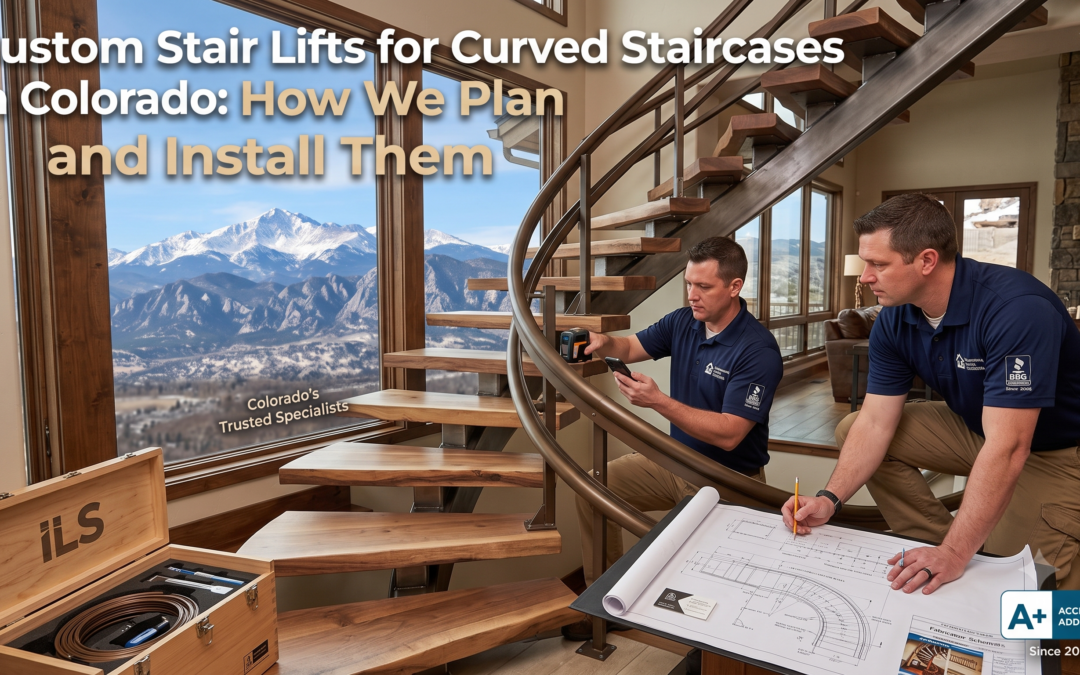
- Photography and detailed measurement. We document the staircase with photographs and take comprehensive measurements of every dimension the fabricator will need. This includes tread depth, riser height, angles at every turn, landing dimensions, and clearance from walls and handrails.
- CAD rail design and approval. The measurements are submitted to the manufacturer, who produces a CAD drawing of the proposed rail. In most cases, we share this with the homeowner for review before fabrication begins.
- Approval and fabrication. Once the design is approved, the rail goes into production. Fabrication lead time varies by manufacturer and order volume. We communicate the timeline clearly and follow up with updates.
- Stock straight rails versus custom curved fabrication. Straight stair lifts for sale from our local warehouse are often available for same-week installation. Custom curved rails take longer, and homeowners should plan for this when timing is a factor.
As a BBB A+ accredited provider of custom stair lifts for curved staircases in Colorado, our process is built around precision from the first measurement to the final safety check.
Installation Best Practices We Follow
The installation of a curved stair lift is more involved than a straight installation, and the practices our technicians follow reflect that complexity.
- Minimal wall intrusion. The rail is mounted to the stair treads, not the wall, which preserves the structural and aesthetic integrity of the staircase and means no wall patching is required if the lift is ever removed.
- Preserving staircase integrity. We use appropriate fasteners and mounting hardware for the stair tread material. Hardwood treads, carpeted treads, and tile treads all require different approaches.
- Power supply integration. The lift needs a power source, typically a standard outlet near the top or bottom of the staircase. If one does not exist, we coordinate with an electrician in advance.
- Load testing and emergency function testing. Every installation is tested under load before we leave. Emergency stop functions, obstruction sensors, and call and send remotes are all verified as part of the standard process.
- User training on parking positions and call stations. Curved lifts have specific parking positions at the top and bottom of the staircase where the chair must be parked to keep the staircase clear for other household members. We walk through this and all other operating procedures before the installation is considered complete. We do not consider an installation complete until the homeowner is fully comfortable operating the system. That standard is part of why we have maintained our A+ BBB rating for over 15 years.
Repair and Maintenance for Custom Lifts
Because every curved stair lift rail is unique, maintenance and repair for these systems require familiarity with the specific installation. This is one of the clearest reasons why local service matters for curved lift owners.
- Annual service recommendation. We recommend an annual service visit for all curved stair lifts. A trained technician inspects rail alignment, drive mechanism condition, battery health, and safety sensor function. Catching small issues early prevents larger failures.
- Common issues over time. Rail alignment can shift slightly as a home settles or as temperature changes affect the staircase structure. Motor wear, battery degradation, and occasional sensor calibration drift are the most common issues we address during service calls.
- Battery replacement. Most stair lift batteries have a service life of several years. We track battery age for our service customers and recommend replacement proactively rather than waiting for a failure.
- Warranty considerations. New curved stair lift installations through our team carry a one-year labor warranty. Manufacturer warranties cover equipment defects beyond that period. We also offer service plans for ongoing scheduled maintenance.
- Why local service matters for custom equipment. A curved rail that was fabricated for a specific staircase in a specific home is not something a remote service center can diagnose over the phone. Curved stair lift repair in Colorado requires a technician who can come to the home, assess the specific installation, and work with equipment they know.
For curved stair lift repair in Colorado, our team serves the Front Range and surrounding communities with local response times.
Cost Guide: Custom vs. Straight Stair Lifts
Understanding cost differences between curved and straight systems helps families plan realistically.
| Stair Lift Type | Typical Price Range | Condition | Notes |
| Curved Stair Lift | Starting around $14,000 | New (Custom) | Price varies with staircase complexity |
| Straight Stair Lift | $4,100 – $4,900 | New | Standard rail, in-stock units available |
| Straight Stair Lift | $2,900 – $3,700 | Certified Pre-Owned | Same installation warranty |
| Hybrid (Two Straight Lifts) | Varies | New or Pre-Owned | For some landing configurations |
- Curved stair lifts start around $14,000 installed, with pricing increasing based on the complexity of the rail geometry, the number of turns, and the length of the staircase. More complex configurations can exceed this starting point.
- Straight stair lifts for sale from our inventory run $4,100 to $4,900 new and $2,900 to $3,700 for certified pre-owned units. These are meaningfully more affordable, which is why confirming the staircase type during assessment is the first step.
- Reconditioned options are limited for curved lifts. Because each curved rail is custom-made for a specific staircase, pre-owned curved lift components rarely transfer to a different home. We are transparent about this, so families are not expecting a used curved lift option that does not exist.
- Financing is available. We work with families who need to spread the cost over time. Financing options are discussed during the assessment and applied to the final quote.
Your Curved Staircase Is Not a Barrier
Curved and complex staircases do not have to end the conversation about aging in place. With the right custom stair lifts for curved staircases in Colorado, nearly any staircase configuration can be made fully accessible without altering the home’s structure or appearance.
Our BBB A+ accredited team has completed curved stair lift installations across Colorado, and every one started with a free in-home assessment. If you are ready to find out what is possible in your home, visit our website to learn more about our curved lift options or call us at (303) 463-8200. You can also reach us by email at info@independentlivingsolutionsinc.com or visit our showroom at 6225 W. 48th Ave. #108, Wheat Ridge. There is no obligation, and we will give you an honest answer about what will work for your staircase.
Frequently Asked Questions
Q: Can a curved stair lift be installed on any staircase?
In most cases, yes. The custom fabrication process allows curved residential chair lifts to be built for nearly any staircase geometry, including spirals, 90-degree turns, 180-degree switchbacks, and configurations with intermediate landings. The limiting factors are clearance width, which must be adequate for the chair to travel without obstruction, and the condition of the stair treads, which must be structurally sound to support the rail mounting hardware. We confirm both during the free in-home assessment before any equipment is ordered.
Q: How long does a curved stair lift installation take?
Installation typically takes four to six hours once the custom rail arrives. The rail must be fitted to the staircase, adjusted for precise alignment, and fully tested before the installation is complete. This is longer than a straight lift installation but is completed in a single visit in most cases. Total time from initial assessment to completed installation includes fabrication lead time, which varies by manufacturer.
Q: What should I do if my curved stair lift stops working?
Call us directly at (303) 463-8200. For curved stair lift repair in Colorado, we send a technician to the home to assess the specific installation rather than attempting to diagnose remotely. In the meantime, check whether the lift is showing an error indicator on the control panel and whether the power supply is intact. Do not attempt to manually force the chair along the rail. Our team handles all repairs on equipment we have installed, and manufacturer warranties cover qualifying repair needs on newer units.
Q: Is a curved stair lift worth the higher cost compared to moving?
For most families, yes. The cost of a curved stair lift, while higher than a straight unit, is a fraction of what assisted living or long-term care facilities cost annually in Colorado. Many families we work with have compared the numbers directly. Staying in a familiar home, with full access to every level, also carries quality-of-life value that is difficult to price. If the primary concern is cost, we walk through all available options during the assessment, including financing, to make sure the investment is manageable.