
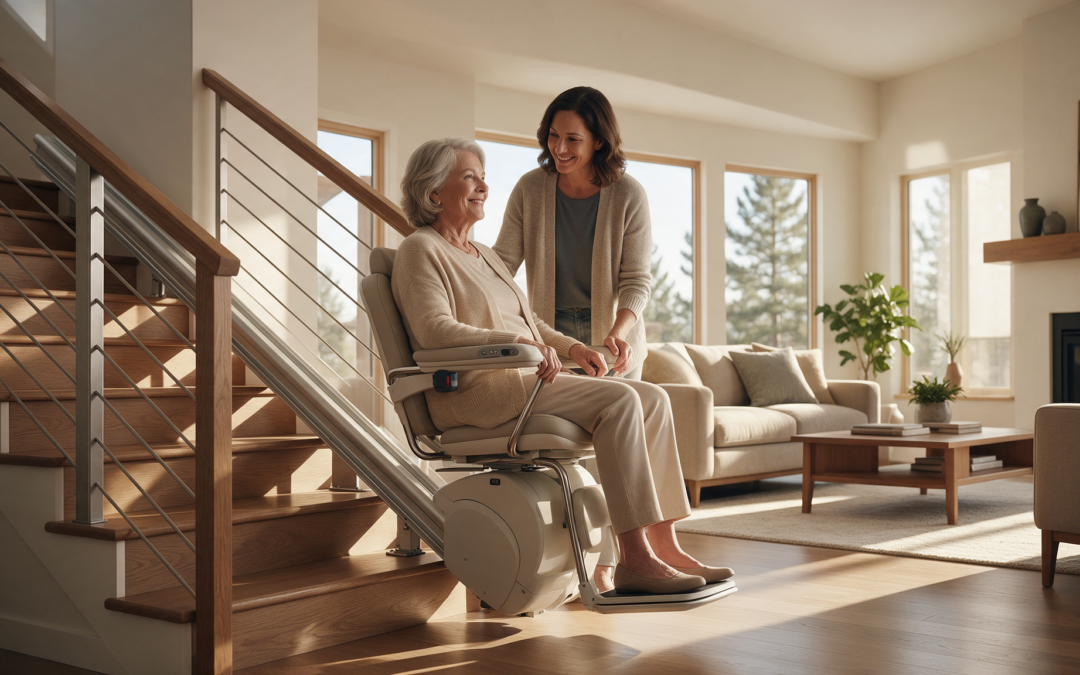
Stair lifts in Colorado are chosen by families who want to age in place safely without home renovation or relocation. The rail mounts to stair treads, not walls, requiring no structural changes. Battery-operated systems continue working during power outages. New straight lifts start at $4,100 to $4,900 installed. Curved lifts start around $16,000. Independent Living Solutions in Wheat Ridge serves the greater Denver area and Front Range communities.
Every year I do dozens of in-home assessments, and the story I hear most often goes something like this. Someone had a close call on the stairs. Maybe they grabbed the railing harder than usual. Maybe there was an actual fall, and the family is now scared. They don’t want to move. They don’t want assisted living. They just want the stairs to stop being a threat.
Stair lifts across Colorado are solving that problem for more families every year. Not because it’s trendy. Because the alternative, moving out of a home you’ve lived in for decades, costs more, disrupts more, and often makes things worse rather than better.
Table of Contents
- The Real Cost of Stairs for Colorado Seniors
- How Stair Lifts Are Installed Without Disrupting Your Home
- Battery Operation and Colorado Power Outages
- When a Stair Lift Is the Right Fit, and When It Isn’t
- Comparing Home Accessibility Options Side by Side
- Taking the First Step With a Free Assessment
- Frequently Asked Questions
The Real Cost of Stairs for Colorado Seniors
The CDC reports that falls are the leading cause of injury-related death among adults 65 and older. Stairs are one of the highest-risk locations in the home. I don’t lead with that statistic to scare anyone. I mention it because most families I meet don’t think about the staircase as a hazard until something happens. By then, they’re reactive instead of proactive.
The financial and emotional cost of a fall on the stairs is significant. Hospital visits, recovery time, caregiver burden, and sometimes a move that wasn’t planned and wasn’t wanted. A stair lift isn’t a luxury. For a lot of people, it’s what keeps them in their home.
Colorado’s housing market makes the relocation alternative even harder to justify. Downsizing to a single-level home in the Denver metro means competing in a market that’s priced a lot of seniors out. A stair lift, by comparison, is a one-time investment in a home you already own.
How Stair Lifts Are Installed Without Disrupting Your Home
This surprises people every time. The rail doesn’t attach to the wall. It mounts directly to the stair treads using hardware sized for the tread material. Chase, my technician, completes most straight stair lift installations in two to four hours. The house is functional the whole time.
No structural changes. No drywall repair. No painter is coming back to touch up screw holes. The staircase looks the same after installation as it did before, except there’s now a rail and a chair along one side. We install lifts from Harmar, which offer a range of straight and curved configurations that most Colorado homes need.
At the top of the staircase, the chair swivels to allow a safe dismount without stepping backward onto the stairs. The seat, armrests, and footrest all fold flat when the lift is parked, so others in the household can use the stairs normally. I walk every household member through this on installation day, not just the person using the lift.
Battery Operation and Colorado Power Outages
Mountain communities above the Front Range lose power more often than the Denver metro. But winter storms hit the metro too, and when they do, the timing is rarely convenient.
Every stair lift we install operates as a battery-powered system. The chair runs on a battery whether or not the home has electricity. When wall power is present, the batteries charge automatically. When power goes out, the lift keeps working. I’ve never had a customer stranded on a staircase mid-trip because the power went out.
The battery condition should be checked during annual maintenance. I recommend it every year for any lift, straight or curved. A degraded battery doesn’t always announce itself. Chase catches it during service before it becomes a problem.
When a Stair Lift Is the Right Fit, and When It Isn’t
A stair lift is designed for a user who can transfer from a standing position or a wheelchair to the seat. The ride itself requires nothing from the user other than pressing the paddle switch control. But that transfer, getting into and out of the chair at the top and bottom, requires some balance and leg strength.
For users who can’t make that transfer safely, a vertical platform lift is often the better solution. A platform lift moves the user and their mobility device straight up and down without any transfer. No seat, no pivot, no step. Different mechanism, different use case.
For porch access or exterior steps where a ramp isn’t practical, a modular aluminum ramp is sometimes the cleanest answer. I always look at the full path of travel through a home during an assessment, because solving one access point and missing another one nearby doesn’t help the person much.
Comparing Home Accessibility Options Side by Side
Families often come to me having already decided on a stair lift based on something they read online. Sometimes that’s right. Sometimes it’s not. Here’s how the main options compare for a typical Colorado home scenario.
| Solution | Best For | Starting Price | Install Time |
| Straight stair lift (new) | Single straight staircase, the user can transfer | $4,100 to $4,900 | 2 to 4 hours |
| Straight stair lift (pre-owned) | Same as above, budget-conscious | $2,900 to $3,700 | 2 to 4 hours |
| Curved stair lift | Staircases with turns, multiple landings | Around $16,000 | 6 to 10 hours |
| Vertical platform lift | Wheelchair users, no transfer possible | Varies by model | Varies |
| Modular ramp | Exterior steps, porch access | Varies by length | 1 to 2 days |
| Residential elevator | Full floor access, multi-story home | Higher investment | Multi-day |
Pre-owned straight lifts go through the same professional inspection as new units and are installed the same way. The difference is in the cost and warranty terms. I’ll tell you which makes sense for your situation based on the staircase and your expected use.
What most people don’t know about home accessibility solutions is that the best one is rarely the most expensive one. It’s the one that matches the person’s mobility, the staircase geometry, and the daily routine.
Taking the First Step With a Free Assessment
We’ve been doing this for over 20 years from our location in Wheat Ridge, which puts us central to the greater Denver area and within reach of most Front Range communities. We’re not a franchise and definitely not a call center. When you call (303) 463-8200, you get a real person.
The in-home assessment is free. I come to your home, look at the staircase, ask about the person using the lift, and give you an honest recommendation and a transparent price. If a stair lift isn’t the right answer for your situation, I’ll tell you that too. Our curved stair lifts page has more detail if your staircase has turns or multiple sections.
You can also reach me at info@independentlivingsolutionsinc.com or stop by the showroom at 6225 W. 48th Ave. #108 in Wheat Ridge to sit in the equipment before you decide anything.
Frequently Asked Questions
Q1: How do stair lifts reduce fall risk for seniors at home?
A: They eliminate the need to physically climb or descend the stairs, which is where most household falls among seniors occur. The lift carries the user between floors while seated, with safety sensors that stop the chair if anything is in the path. According to the CDC, falls are the leading cause of injury-related death among older adults, and staircase hazards are a primary factor.
Q2: Can a stair lift be installed on any staircase?
A: Most staircases can accommodate a stair lift. Straight staircases are the simplest. Curved staircases with turns or multiple landings require a custom-fabricated rail and a longer installation process. I confirm fit during the free in-home assessment before anything is ordered.
Q3: What happens to the stair lift if the power goes out?
A: Nothing bad. Every lift we install operates on a battery system that doesn’t depend on wall power. The batteries charge when electricity is available and run the lift independently when it isn’t. This matters a lot in mountain communities and during Colorado winter storms.
Q4: How long does a stair lift last?
A: Most well-maintained stair lifts last ten years or longer. Battery condition, drive mechanism wear, and rail alignment are the main maintenance items. Annual service from Chase keeps those in check. We service everything we sell and install.
Q5: Is a stair lift better than moving to a single-level home?
A: For most families, yes. The cost of a stair lift is a one-time investment compared to the ongoing cost and disruption of relocation. Denver’s single-level housing market is competitive and expensive. A stair lift keeps you in your home with full access to every level.
Q6: What is the difference between a stair lift and a vertical platform lift?
A: A stair lift carries a seated user along a rail mounted to the staircase. A vertical platform lift moves the user straight up or down on a flat platform without requiring them to transfer to a seat. Platform lifts work for wheelchair users or anyone who can’t safely pivot into a chair. We install both. See our vertical platform lifts page for more details.