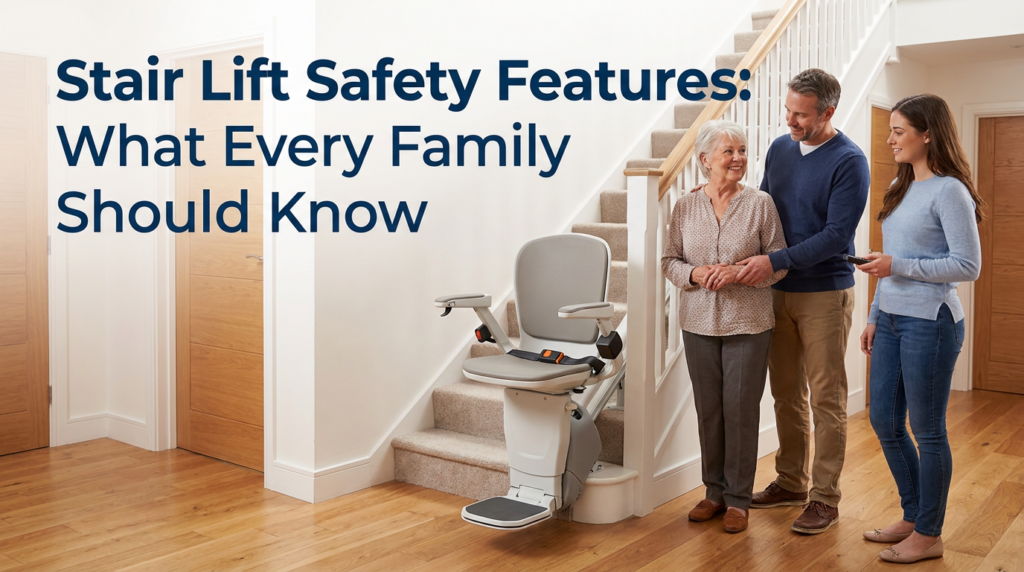
Every family that calls about a stair lift has the same concern beneath the surface: Will Mom or Dad actually be safe on this thing? It’s a fair question. A stair lift is a piece of motorized equipment that carries someone you love up and down a staircase. Safety isn’t a feature – it’s the foundation.
At Independent Living Solutions, we have installed stair lifts in hundreds of Colorado homes, from narrow Victorian staircases in Denver to split-level ranches in Colorado Springs. We’ve seen what works, what families worry about, and which stair lift safety features matter most in real daily use.
This guide covers the essential stair lift safety features every family should understand before choosing equipment. No technical jargon. Just practical information from a team that’s trained Colorado homeowners on hundreds of installations.
Why Safety Features Matter More Than the Sales Pitch
It’s easy to get distracted by price, brand names, or installation timelines. But when the lift is running at 10 PM, and a parent is riding it alone in a quiet house, only the stair lift safety features matter.
The right safety systems prevent falls. They protect against user error. They keep the lift functioning during power outages, emergencies, and everyday moments of uncertainty. And they give adult children (the ones often researching this purchase) peace of mind that their parent is safe, even when nobody else is home.
I approach every assessment with this priority: the lift must be safe enough that I’d put my own family on it.
Essential Stair Lift Safety Features: What to Look For
Not all stair lifts include the same safety systems. Some manufacturers treat features as upgrades. At Independent Living Solutions, we believe these six stair lift safety features should be standard, not optional.
1. Seat Belt and Secure Positioning
A simple lap belt is the first line of protection. It prevents the rider from sliding or shifting during travel, especially on steep staircases common in Evergreen and mountain communities. The belt should be easy to fasten one-handed but secure enough to hold during stops and starts.
Some models include retractable belts that stay tidy when not in use. Others have center-mount designs for easier reach. During a free in-home assessment, I demonstrate how each belt works so families can choose what feels natural for the rider.
2. Swivel Seat with Locking Mechanism
At the top of the stairs, the biggest fall risk isn’t the ride—it’s the transfer. A swivel seat turns 45 or 90 degrees at the landing, allowing the rider to step off facing away from the staircase. The seat then locks in position, so it can’t accidentally rotate mid-transfer.
This feature is non-negotiable for upper-floor safety. We always demonstrate the swivel function during installation and watch the rider practice it before leaving. If hand strength is limited, powered swivel options are available that rotate automatically at the touch of a button.
3. Obstruction Sensors
Modern stair lifts include sensors on the footrest and carriage that detect objects on the stairs, such as a laundry basket, a pet, or a grandchild’s toy. If the sensor triggers, the lift stops immediately. It won’t resume until the path is clear.
This matters in busy Colorado households where stairs double as storage during Denver winters (boots, coats, gear) or where pets move freely. We test these sensors during every installation to confirm they’re calibrated correctly for the specific staircase width and traffic patterns.
4. Battery Backup and Power Outage Protection
Colorado’s mountain communities and Front Range suburbs see power outages from snowstorms, high winds, and grid stress. A stair lift stranded mid-staircase during an outage isn’t just inconvenient; it’s dangerous.
Battery-powered lifts continue operating during outages, typically completing 8–15 trips on reserve power. The batteries charge automatically when the lift is parked at the top or bottom of the rail. This is one of the stair lift safety features I emphasize for homes in Evergreen, Colorado Springs, and anywhere winter weather is unpredictable.
5. Smooth Start and Stop Technology
Jerky movement startles riders. It causes them to grip the armrests, lean, or lose balance. Quality lifts include soft-start and soft-stop motors that accelerate and decelerate gradually.
This is especially important for riders with balance issues, Parkinson ‘s-related movement disorders, or anxiety about the equipment. We always run the lift through several cycles during installation so the rider feels the smooth motion before using it independently.
6. Folding Components and Clear Passage
When not in use, the seat, footrest, and armrests should fold flat against the wall. This keeps the staircase passable for other family members and reduces tripping hazards.
Folding should be simple – manual for most users, powered for those with limited dexterity or strength. I measure staircase width during assessment to confirm folded dimensions leave adequate walking space. In older Denver homes with narrow staircases, this measurement determines whether a lift is viable at all.
Safety Features for Specific Colorado Home Environments
Colorado homes present unique challenges that affect which stair lift safety features matter most.
| Home Type | Common Challenge | Recommended Safety Feature |
| Mountain homes (Evergreen, Conifer) | Steep stairs, power outages | Battery backup, higher weight capacity, secure seat belt |
| Historic Denver properties | Narrow staircases, tight landings | Slim-fold design, swivel seat with limited clearance, obstruction sensors |
| Post-war ranch split-levels (Wheat Ridge, Lakewood) | Short half-flights, multiple entries | Smooth start/stop, easy folding for shared stairs |
| Multi-generational homes | Children, pets, high traffic | Obstruction sensors, automatic folding, keyed on/off switch |
| Cold-climate entries | Icy boots, wet surfaces | Non-slip footrest texture, stable armrest grip |
Chase and I evaluate these environmental factors during every free in-home assessment. A lift that’s perfect for a Denver bungalow may be wrong for a Colorado Springs two-story. Safety features must match the home, not just the rider.
Our Installation Safety Process:
Safety features on paper mean nothing if installation is rushed or training is skipped. At Independent Living Solutions, our installation process includes specific safety protocols:
Step 1: Structural evaluation
Chase inspects the staircase itself – tread condition, railing stability, and wall integrity. The lift mounts to the stairs, not the wall, but the structure must be sound.
Step 2: Rail alignment and anchoring
Every bracket is torque-checked. The rail is leveled precisely. Even minor misalignment can cause binding, noise, or premature wear that compromises safety.
Step 3: Feature testing
Every sensor, belt, swivel lock, and battery system is tested multiple times under load. We don’t assume factory calibration is correct for your specific staircase.
Step 4: Rider training
The rider practices getting on, operating controls, swiveling at the top, folding the seat, and using the remote. Family members are included so they can assist if needed. Nobody is left alone with new equipment until they’re confident.
Step 5: Documentation
Written operating instructions, emergency procedures, and direct contact information for service. Our 1-year labor warranty covers installation-related issues, and Preventive Maintenance plans are available for ongoing safety checks.
When We Recommend Alternatives
Sometimes during assessment, I identify that a stair lift isn’t the safest solution. Maybe the staircase is too narrow for safe passage when folded. Maybe the rider’s condition is progressing rapidly, and a vertical lift or home elevator is a better long-term investment. Maybe the stairs themselves are structurally compromised.
In these cases, we recommend alternatives: vertical platform lifts for wheelchair users, residential elevators for multi-floor access, or home modifications that address the root issue. Our buy-back program applies if needs change later.
This honesty is part of safety too – matching the right equipment to the actual need, not selling what happens to be in stock.
Get Started: A Safety-First Assessment for Your Colorado Home
If your family is researching stair lifts for a parent, spouse, or loved one, the right next step is a free, no-obligation assessment. No pressure. No commitment. Just an honest evaluation of your staircase, your needs, and which safety features matter most for your situation.
I’ll come to your home, measure your staircase, demonstrate how key safety systems work, and leave you with a detailed quote. Chase handles installation personally, and he doesn’t leave until everyone is comfortable and confident.
Learn more about stair lift options and safety features at Independent Living Solutions. Or call (303) 463-8200 or email info@independentlivingsolutionsinc.com.
FAQ’s
What stair lift safety features are most important for seniors living alone?
Battery backup, obstruction sensors, and a secure swivel seat with a locking mechanism top the list. These features protect against power outages, household obstacles, and the biggest fall risk, transferring at the top landing. During a free assessment, we demonstrate each feature so families can prioritize based on the specific home environment.
Are stair lifts safe during a Colorado winter power outage?Yes, if the lift has battery backup. Battery-operated models continue operating during outages, typically completing multiple trips on reserve power. This is one of the stair lift safety features we emphasize for mountain communities and anywhere winter storms affect the grid. The batteries recharge automatically when the lift is parked at its charging station.
How do I know if my staircase is safe for a stair lift installation?The only reliable way is a professional assessment. We evaluate staircase width, tread condition, structural integrity, and landing space. In rare cases, a staircase is too narrow or deteriorated for safe installation. When that happens, we recommend alternatives like vertical lifts or home elevators. Independent Living Solutions offers free assessments with no obligation to proceed.
What happens if something goes wrong with the lift after installation?All new installations include a 1-year labor warranty. If a safety feature malfunctions or the lift stops operating correctly, call (303) 463-8200. We prioritize safety-related service calls and often respond same-day for urgent issues. Preventive Maintenance plans are also available for scheduled inspections that catch problems before they become dangerous.